

Date & time
Wednesday, March 11, 2026
3 p.m. – 4 p.m.
3 p.m. – 4 p.m.


Camilo Alejo and Angela Kross
This event is free and open to the public but please register
Loyola College for Diversity & Sustainability/Sustainability Research Center & School of Health
Online
This event is part of the Planetary, public, and personal health, well-being, and justice conference
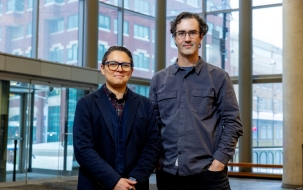 Camilo Alejo and Damon Matthews
Nature-based Solutions (NbS) aim to enhance nature to tackle pressing challenges like climate change and biodiversity loss. In this panel, Camilo Alejo and Angela Kross will discuss their ground-breaking work on NbS.
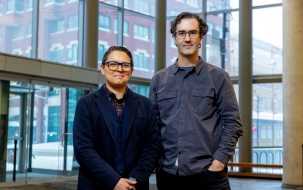 Camilo Alejo and Damon Matthews
Across the globe, Indigenous Peoples are leading NbS (i.e., Indigenous-led NbS) such as Indigenous Protected Conserved Areas and Indigenous Guardians programs. Previous studies have explored their potential environmental outcomes. Our study builds on these studies to understand how government financial support to Indigenous-led NbS influences carbon storage in plants and soil and biodiversity conservation. We focus on Canada as it offers valuable insights about the ways substantial government support may influence Indigenous led NbS. Our results show that Indigenous led NbS carbon storage and biodiversity conservation outcomes are similar to existing Protected Areas. Moreover, government funding to Indigenous-led NbS was related to lower carbon emissions from land use change compared to Protected Areas. By analyzing Indigenous-led NbS project descriptions, we found that environmental outcomes emerge from reciprocal relationships between people and the natural world. For example, knowledge exchange between youth and elders is essential for environmental health. Overall, government support for Indigenous-led NbS may align climate and biodiversity benefits with some aspects of Indigenous self-determination, but these positive outcomes will only continue with long-term financial commitment and full recognition of Indigenous rights.
Camilo Alejo is a Postdoctoral Fellow at the Canada Hub of FutureEarth and in the Department of Geography, Planning and Environment at Concordia University. He is interested in understanding the current and potential nature-based solutions emerging from Indigenous Peoples and Local Communities across the American continent. Camilo holds a B.Sc. in Biology from Universidad de Los Andes (Colombia), M.Sc. in Biodiversity Conservation and Use from Pontificia Universidad Javeriana (Colombia), and a Ph.D. in Biology from McGill University (Canada).
Camilo will be presenting work published in collaboration with Graeme Reed (Assembly of First Nations and York University) and Damon Matthews (Concordia University).
Alejo, C., Reed, G. and Matthews, H.D., 2025. Indigenous‐led nature‐based solutions align net‐zero emissions and biodiversity targets in Canada. Earth's Future, 13(10), p.e2025EF006427.
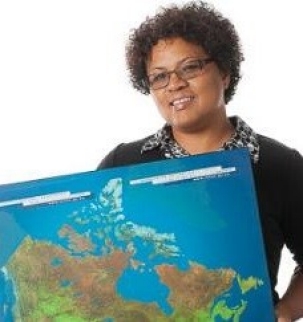 Angela Kross
Angela Kross is Associate Professor in the Department of Geography, Planning and Environment specializaing in Remote Sensing and Geospatial Technologies. She has an M.Sc in Geographic Information Science / Remote Sensing from Wageningen University and Research Centre in the Netherlands and a Ph.D in Physical Geography / Remote Sensing from McGill University. Prior to joining Concordia in August 2015, she was a post doctoral researcher at Agriculture and Agri-Food Canada. In her research she uses GIS and Remote Sensing technologies in combination with ground measurements and models to answer questions related to ecosystem processes, vegetation development and land use change in response to anthropogenic and natural events, such as agriculture practices, mining activities and climate change.
This event is brought to you by the Loyola College for Diversity and Sustainability and the Loyola Sustainability Research Centre in partnership with the School of Health, with generous support from Future Earth and the Department of Department of Geography, Planning and Environment.