
Date & time
Friday, June 12, 2026
6:45 p.m. – 8 p.m.
6:45 p.m. – 8 p.m.


Hybrid
Adam Wilkins, Lauren Stephens Smith, Rania Masri, Mél Hogan, Simon Enoch
This event is free.
SHIFT Centre for Social Transformation
J.W. McConnell Building
1400 De Maisonneuve Blvd. W.
Yes - See details
UPDATE: The Podcast with Mél Hogan is now live!
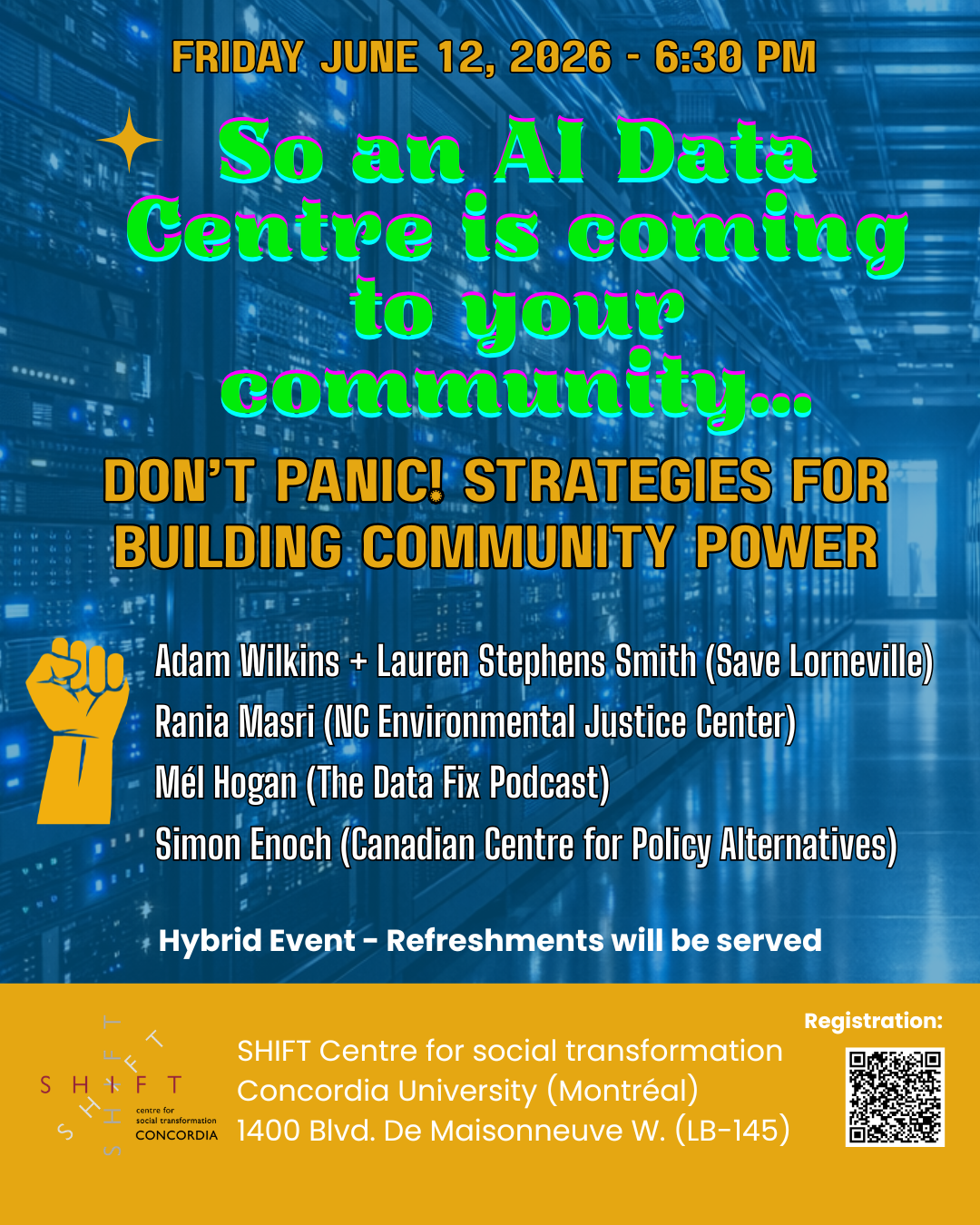
Join us as we hear from speakers who are waging citizen-led campaigns against data centres in their backyard.
We will discuss the promise and hype of AI, the social and environmental impacts of AI data centres, the unsavory connection between the tech oligopoly and captured governments attempting to impose AI and AI data centres on the population and across the landscape. Lastly, we will discuss concrete strategies for how communities have been organizing and how to scale up the struggle.
This will be a hybrid event: Register here and let us know if you will join us in person or online.
Refreshments will be served.
The event starts at 6:30 - 6:45 in person, and at 7:00 pm online.
Rania Masri is the Director of Organizing and Policy at the North Carolina Environmental Justice Network. She has organized for justice and against systems of oppression and wars—through protests, teach-ins, and conferences; political organizing; public speaking training; and writings, research, and media work. She taught holistic environmental sciences (including environmental justice) at the university level for nearly two decades.
Simon Enoch is the senior researcher for Saskatchewan issues and policies at the Canadian Centre for Policy Alternatives. He holds a BA in Political Science, a Masters in Labour Studies and a PhD in Communication & Culture and is active in both the labour movement and media reform efforts.
Mél Hogan is the host of The Data Fix Podcast and editor of Heliotrope (heliotropejournal.net). She is Associate Professor in Film & Media at Queen’s University (Canada). Her research focuses on data centres in the contexts of planetary catastrophes and collective anxieties about the future. You can follow her on Bluesky at @melhogan.bsky.social
Elected governments and big tech corporations are teaming up to take over territories for AI-data centres, often under the framing of “data sovereignty” in the global AI-race. Yet, data centres sap enormous amounts of resources, destroy landscapes, pollute our water and air, and increasingly serve a war-driven economy premised on death and short-term profits. For marginal benefits to everyday life and to speed up the treadmill of production and exhaustion, our governments and the tech oligopoly are literally sabotaging the last strands of our planet’s life-support systems. While the situation seems dire, we can and must build collective power to reject data centres branded in the name of hyped-up employment opportunities and local development.
As members of the Data Center Working Group have contributed, there are many reasons to stop the spread of data centers. Here are some:
Maybe you want water and energy to be prioritized for people?
Maybe you believe in respecting Indigenous communities over unceded land?
Maybe you don’t want your energy bill to go up to subsidize the richest people and companies in the world?
Maybe you think Big Tech should not get tax breaks while we must accept imposed cuts to our public services
Maybe you don’t want Big Tech to cement its dystopian vision for the future?
Maybe you don’t like the destruction of vulnerable ecosystems, rare species, and migratory routes for more AI slop mush content that erases generations of knowledge, our own cognition and control of our own thought, and could lead to social breakdown
Maybe you don’t want to support companies tied to weapons manufacturers that use generative AI for efficiently killing people in Gaza and elsewhere
Social Justice Centre (Concordia), SCPA Student Association (SCPSA), School for Community and Public Affairs (Concordia), Climate Justice Montreal, Center for Interdisciplinary Research on Time, Technology, and Capitalism (Concordia), Confronting Emergent Dystopia Working Group (Concordia).