Date & time
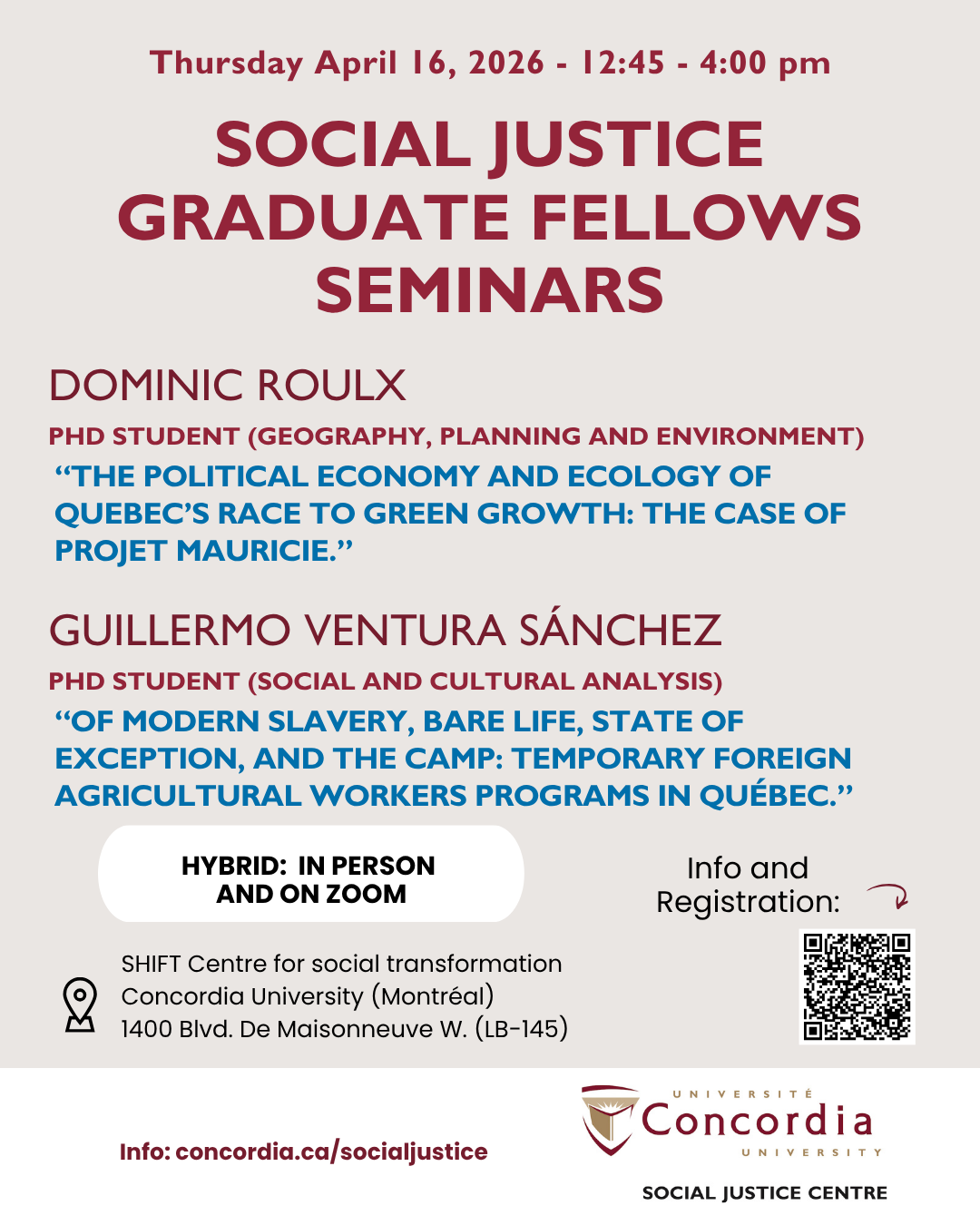
Thursday, April 16, 2026
12:45 p.m. – 4 p.m.
12:45 p.m. – 4 p.m.


Dominic Roulx, Guillermo Ventura Sánchez
This event is free.
SHIFT Centre for Social Transformation
J.W. McConnell Building
1400 De Maisonneuve Blvd. W.
Room Conference room
Yes - See details
Join us for the first session of our 2025-26 Social Justice Graduate Fellow Seminars.
The goal of these seminars is to give constructive feedback to our fellows on their work-in-progress.
Each talk will last 30-35 minutes, followed by an invited commentary of 5-10 minutes, and a discussion of 15-20 minutes.
Vegan snacks and refreshments will be served. Everyone is welcome.
Note: Please arrive early to get coffee and snacks, so we can start at 1 pm on the zoom.
In person: The conference room of the SHIFT Centre for Social Transformation (LB-145 in the J. W. Mc Connell Building) or remotely on zoom.
Please register here and indicate on the zoom registration if you will join us in person or online.
Dominic Roulx is a PhD student in the department of Geography, Planning, and the Environment.
Project: “The Political Economy and Ecology of Quebec’s Race to Green Growth: The Case of Projet Mauricie”
Dominic examines how green growth programs are designed, hegemonized, and implemented in various contexts. More specifically, he draws on Antonio Gramsci's theory of the state, hegemony, and consent to provide an account of how the “energy transition” is unfolding in Quebec. He is co-founder of Rethinking Gramsci (now Gramsci Research Collective), a Montreal-based research collective dedicated to producing and promoting research and practices inspired by the ideas of Antonio Gramsci.
Respondent: Bengi Akbulut (Co-director of the Social Justice Centre and Associate Professor in the Department of Geography, Planning, and Enviroment)
Guillermo Ventura Sánchez is a PhD student in Social and Cultural Analysis.
Project: “Of Modern Slavery, Bare Life, State of Exception, and the Camp: Temporary Foreign Agricultural Workers Programs in Québec.”
Bridging the theoretical frameworks of Giorgio Agamben and Hannah Arendt, Guillermo aims to develop an analytical tool to expose the mechanisms of dehumanization inherent to the symbiosis between societies and state apparatuses, regardless of the political-economic ideology they endorse.
Respondent: Gabriel Allahdua (former farm worker, organizer with Justicia for Migrant Workers and an outreach worker with The Neighbourhood Organization)