Date & time
Friday, February 6, 2026
1 p.m. – 3 p.m.
1 p.m. – 3 p.m.


This event is free.
J.W. McConnell Building
1400 De Maisonneuve Blvd. W.
Room LB 651
Yes - See details
The first session of the Winter semester will take place on Friday February 6.
The reading will be excerpts from Indians on Indian Lands: Intersections of Race, Caste, and Indigeneity by Nishant Upadhyay (as well as an optional second reading by Phanuel Antwi called "Below Decks in the Covenant: Blackness in the Two Row Tradition")
For access to the texts, please email Cynthia Quarrie (cynthia.quarrie@concordia.ca) two or three weeks ahead of time.
Each meeting runs from 1pm-3pm in LB-651, with snacks and coffee provided.
This interdisciplinary reading group is open to all.
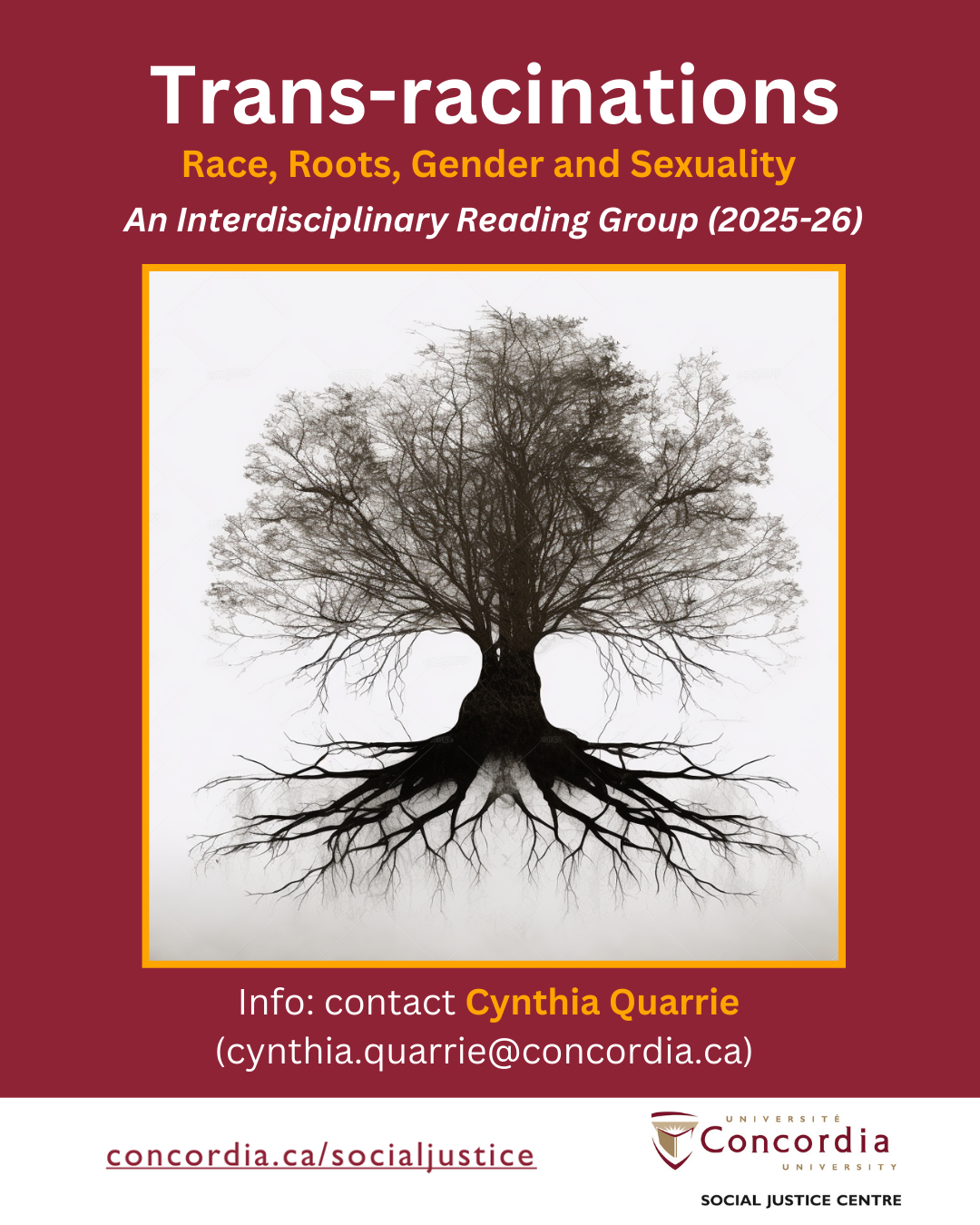
How are gender and sexuality related to notions of “rootedness” and place, and how do they intersect with mobility, passing, crossing? In a political moment marked by resurgent white settler neo-nationisms and the violent policing of gendered identities, can (or should) the metaphor of rootedness be decolonized and reimagined, particularly in ways that engage with gender, race, and sexuality, and that promote more inclusive, reciprocal, and sustainable forms of belonging?
Metaphors of roots and rootedness, and their obverse — rootlessness, deracination, even “eradication”— are, as Christy Wampole puts it, “site[s] of extreme figuration," which suggests the extent to which humans are marked in one way or another by their connection (or lack thereof) to place. Rootedness is often linked to the feminine figure of the mother, whose stasis, domesticity, and “groundedness” maintains an unchanging home base for masculine adventure, violence, and territorial expansion. The figure of the (racialized) mother, uprooted and transported across continents, oceans, and empires, becomes a generative site of aporia and imagination for scholars of transatlantic and transpacific movement. Attachment to place is also at the heart of many anti-colonial struggles, debates around environmental custodianship (the idea that Indigenous Land and Water defenders should lead North American climate movements for example), but also eco-fascist and anti-immigrant nationalisms around the globe.
Can we reimagine connections to land and place in ways that unsettle white supremacy, racial capitalism, settler colonialism, and heteropatriarchy? How might “sacred” attachment to place be re-conceived without reinscribing essentialist mythopoetics that centre heteronormative whiteness? This reading group will explore alternative ways of conceiving rootedness as dynamic, relational, and decolonial—resisting the violence of ownership and territoriality while recognizing the deeply interconnected nature of land, body, and identity.
Co-organized by Cynthia Quarrie, Gage Diabo and Jesse Arsenault.
Friday, Feb 6: excerpts from Indians on Indian Lands: Intersections of Race, Caste, and Indigeneity by Nishant Upadhyay (as well as an optional second reading by Phanuel Antwi called "Below Decks in the Covenant: Blackness in the Two Row Tradition")
Friday, March 13: excerpts from Frottage: Frictions of Intimacy Across the Black Diaspora by Keguro Macharia
Friday, April 10: excerpts from Becoming Human: Matter and Meaning in an Antiblack World by Zakiyyah Iman Jackson
Friday, September 26. Reading: a chapter from C. Riley Snorton's book, Black on Both Sides: A Racial History of Trans Identity. The chapter is titled, "Trans Capable: Fungibility, Fugitivity, and the Matter of Being."
Friday, October 24. Reading: chapters from Saidiya Hartman's 2019 book, Wayward Lives, Beautiful Experiments: Intimate Histories of Riotous Black Girls, Troublesome Women, and Queer Radicals.
Friday November 21. Reading: Lisa Lowe's book, The Intimacies of Four Continents (2015).