

Date & time
Thursday, October 1, 2026
4:30 p.m. – 5:30 p.m.
4:30 p.m. – 5:30 p.m.
Registration is closed


Registration is closed
In-person
Michal B. Paradowski
This event is free.
Grey Nuns Annex
1211-1215 St-Mathieu St.
Room 2.221
Yes - See details
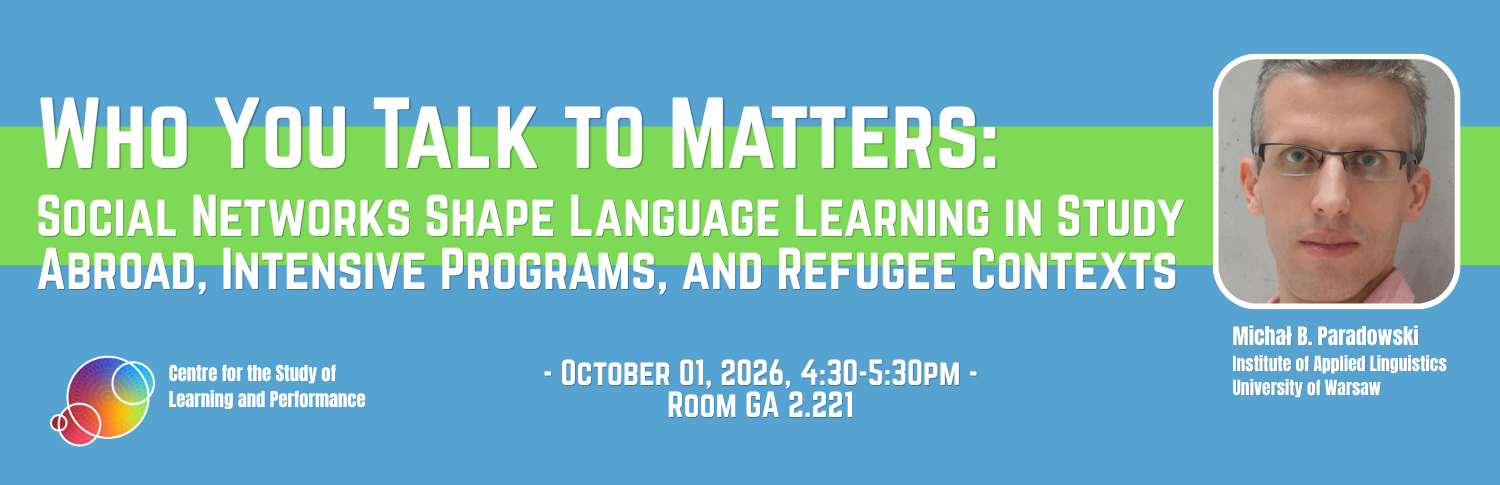
Spending time in a country where the target language is spoken is often assumed to guarantee language gains, as if fluency were simply acquired through exposure. Yet outcomes vary enormously from one learner to the next, even within the same program.
The lecture will show why: what predicts a learner’s progress is not mere immersion, but the shape of the social network constructed during the sojourn – who we talk to, how we are connected to others, and how this social structure changes over time.
Drawing on studies from Erasmus+ study abroad exchanges, intensive language programs, and courses for refugees across a range of countries and target languages, the talk will showcase findings from reconstructing learners’ complete social networks. This whole-network view reveals dynamics invisible to earlier research approaches, casting light on how a learner’s position within a peer group predicts their linguistic progress, how network structures shift over the course of a sojourn, and why relationships among a learner’s peers can matter as much as the learner’s own connections.
The findings carry direct implications for how study-abroad, intensive-program, and refugee-settlement language provision can be more effectively designed and supported, including where and how programs might intervene to help learners build more productive networks, and why more time abroad alone is a poor predictor of success.
Michał B. Paradowski is a professor and teacher trainer at the Institute of Applied Linguistics, University of Warsaw, and a research and language teaching consultant. His interests include second language acquisition and instruction, bi- and multilingualism, psycholinguistics, educational psychology, Study Abroad, and social network analysis. He published over 80 scientific works and delivered more than 270 invited lectures, seminars and workshops across 46 countries.