
Ioana Dragomir

About the Artist
Ioana Dragomir is interested in acts of close reading and translation, interpreting both as creative and transformative. She is guided and moved by desire, which spurs her engagements with texts and archives. Her work is rooted in a post-structuralist logic of shifting/slipping/tenuous connections, of putting things next to each other. Instead of viewing this ungroundedness as threatening, she sees it as flirtatious, an invitation to uncertainty that produces new ways of seeing and being. Much of her work deals explicitly with language, and trying to inhabit the delicious moment of something being on the tip of one’s tongue.
Her recent work functions partially as literary analysis, dealing at times with the grammatics of desire in translations of Sappho’s poetry and floral imagery in Virginia Woolf’s A Room of One’s Own, as well as questioning the role of these texts in a larger cultural context. She is fascinated in how we use these pieces of writing to sell objects, how an ancient Greek poet can reverberate as an icon of contemporary queer love between women, and how these readings are all impacted by capitalism, which is never not separate from literary and artistic worlds.
Ioana Dragomir is an interdisciplinary artist and writer. She has an MA in Art History and Curatorial Studies from Western University and an MFA in Print Media from Concordia University. She has shown her work with Support, Centre Clark, the plumb, and Robert McLaughlin Gallery, among others.
Her artistic practice combines her interest in writing, literary analysis, and curation with drawing, textiles, and installation. In particular, poetic methodologies of juxtaposition, metaphor, and slippage are important to her practice. She loves Sappho, Anne Carson, and Virginia Woolf.
About the project
a pebble in the frog is a body of work created on Gotland. The project Ioana proposed was around language and the island's picture stones — huge sandstone or limestone hunks carved with runes and images. She loved that, because of the passage of time and the loss of their original language, the stones became radically open to interpretation. When she got there, she found that many of the stones featured horses.
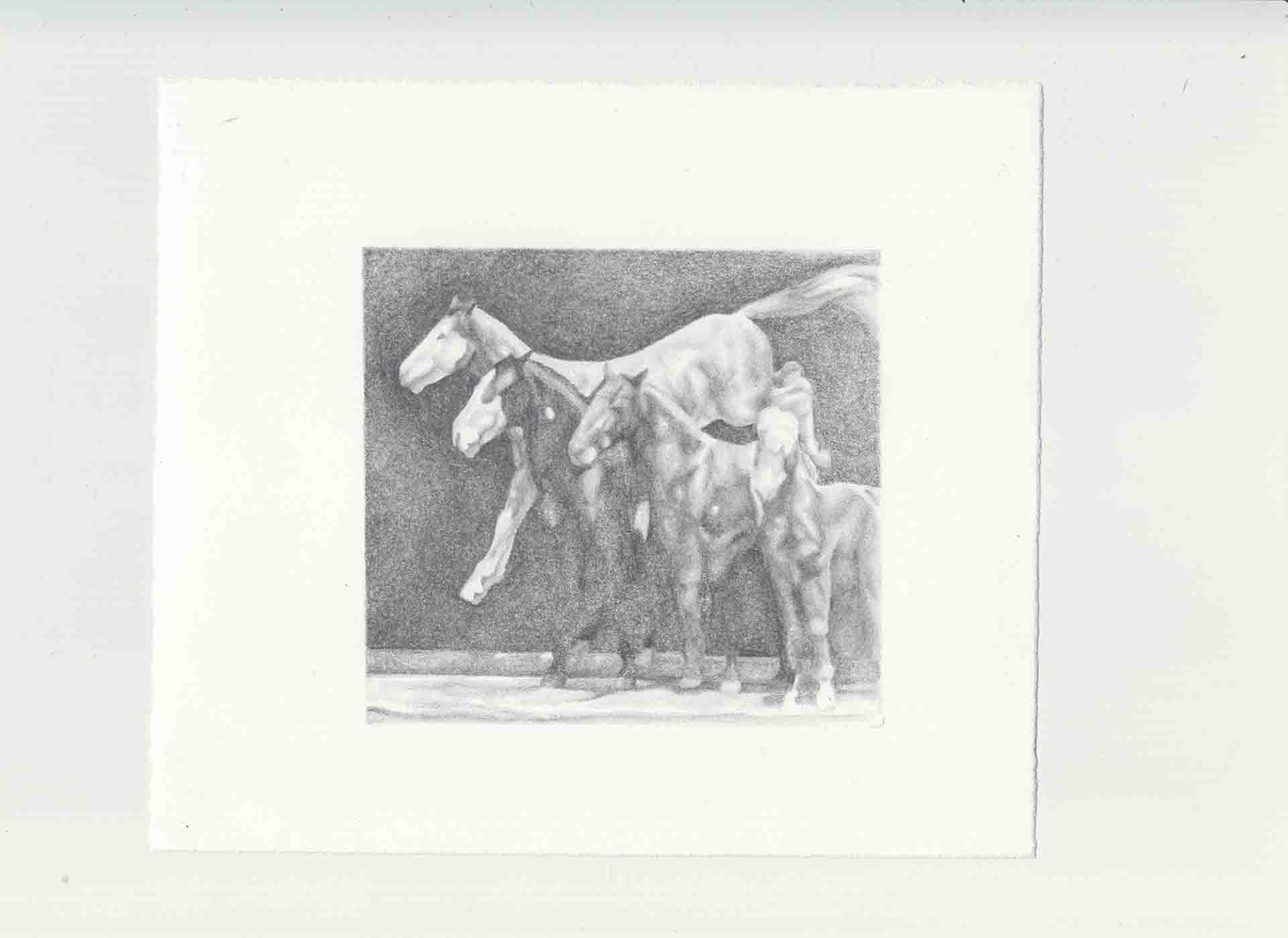
The resulting project is inspired by the stones, her experiences on the island with therapy horses, and Eadweard Muybridge’s photographs of a horse (Hornet) jumping over three other horses.
While on the island, she saw horses:
across the street
in trailers
in the stones
in paintings
in bronze
in the trim of houses
in weathervanes
on clothing
in films
in jewelry
in dreams
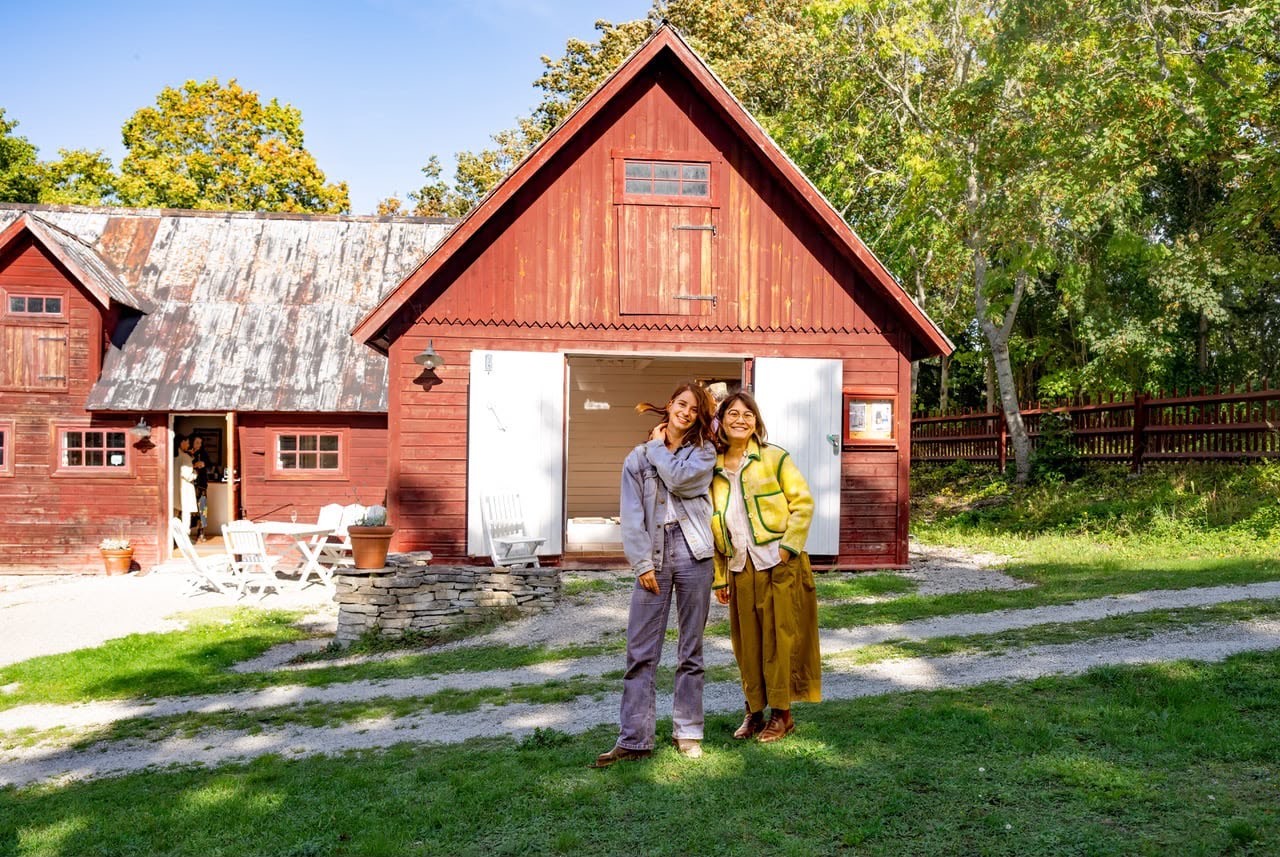
at a barn for equine therapy
And she thought about how time passes differently all the time (how a horse can be stopped mid-trot in a stone) (or stopped mid-jump in a photograph) (but that stone keeps eroding, so did the horse stop?) (and what is the horse in the photographs doing between those twelve frames?) (as in, what could the camera not see?) (and if the stone that the horse is on was carved because a person died, did the horse stop twice?) and how it (time) (or horses) are not uniform.