

Banff Study Days
Banff Centre for Arts and Creativity, Banff, AB
18-19 October 2023
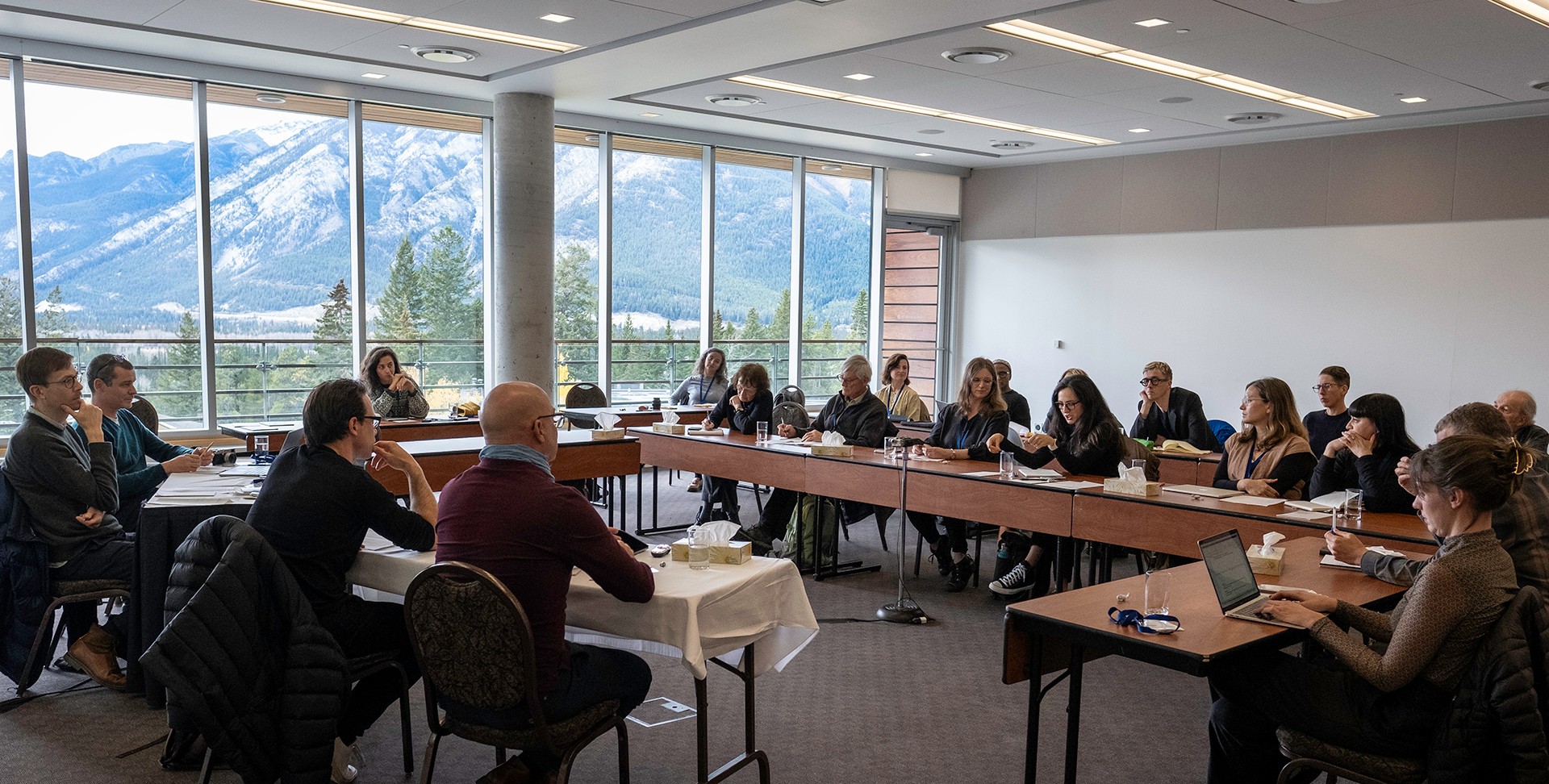 Photo courtesy of Philippe Guillaume. He is a walking artist, photographer and art historian based in Montreal and was a 2016-17 Fellow at the Gail and Stephen A. Jarislowsky Institute for Studies in Canadian Art.
The Future-perfect of Photographic Studies
A workshop organized by Formes actuelles de l’expérience photographique at the Banff Centre for Arts and Creativity, Banff, Alberta, 18-19 October 2023
Program
The program is designed to stimulate discussion. We hope to hear from all the participants in a free and open exchange.
Gil Pasternak’s keynote begins the process. In 2020, Pasternak went to press with his Handbook of Photography Studies. In 2023, we invite Gil Pasternak to reflect on the definition of photography studies that framed this extraordinary contribution, and to share both reverberations from the field and his own afterthoughts.
On our very full day together, two morning sessions will develop some current constructs and productive avenues in research and research-creation, with particular attention to artistic, curatorial, and pedagogical matters. We will break for lunch before anything is resolved.
The afternoon session turns to the perennial and, as we saw in the morning, episodically rearticulated question of photography and truth.
FORMES ACTUELLES DE L'EXPÉRIENCE PHOTOGRAPHIQUE : ÉPISTÉMOLOGIES, PRATIQUES, HISTOIRE is an interdisciplinary, intergenerational, interuniversity, and inter-institutional research team whose individual programs converge on the problematics of photographic knowledge. As a team of established and emerging researchers, as well as key collaborators, we are not just studying the sources of photographic knowledge, we are redefining the field of photographic studies in terms of constellated experience. This study day is the closing event of the research group whose output has also included two Spring Schools and a series of seven thematic books.
Keynote Speaker — Gil Pasternak, De Montfort University, Leicester
“Politics of a Field: Photography Studies and Its Indignations”
Discussion Panel 1 — Anachronism
Martha Langford, Concordia University
Euijung McGillis, National Gallery of Canada
Zoë Tousignant, McCord Stewart Museum
Andrea Kunard, National Gallery of Canada
This panel will circle the question of anachronism (Keith Moxey’s “anachronicity,” in his Visual Time) as it arises from exhibition concepts and organization. In planning this session, Langford, McGillis, and Tousignant have considered certain structural factors that this topic brings to photographic studies. We do so by interlacing the perspectives of a researcher now applying herself to A History of Photography in Canada (Volume 1 under review, McGill-Queen’s University Press); a curator of photography in an art museum of record (National Gallery of Canada); and a curator of photography in a museum of social history, with significant archival holdings and a particular interest in the history of Montreal (McCord Stewart Museum). We will be joined in introducing this discussion by Andrea Kunard, Senior Curator of Photographs Collection, National Gallery of Canada.
Some so-called structural differences might be considered “facts of life” in cultural or educational institutions, namely “the two art histories.” Our presentation faces the gap between the museum (or any memory institution that mobilizes its collection) and the university (with its avowed mission of critical thinking). This has now become a generation gap: in 2002, the Clark Studies in the Visual Arts dedicated a conference and publication to this divide: “different audiences, different values, different conceptions of scholarship and in some cases, mutual suspicion of each other’s professional practices.” (Haxthausen, ed., The Two Art Histories, ix). Contributors to the Clark’s conference and publication were signaling a crisis in the audience’s lack of preparation (historical and stylistic knowledge) with only the barest acknowledgment that audiences were changing/widening – everything was taken as a loss. Twenty years later, things have changed.
While timeliness and relevance to mandate have always affected the activities of the museum, current societal priorities are at the forefront of both planners’ and audiences’ expectations. In a time of “calls to action,” photographic studies as manifest in the museum are expected to contribute to a societal program of decolonization and deracialization that addresses the whitewashing of settler-colonial history and systemic inequities (gender, ethnicity). Museums whose very existence and founding collections contributed to nation-building myths and strategies, such as Canada’s ‘multiculturalism’ of the 1970s, are now attempting to pick these ideas apart. The paradox in some cases is that museum publics have to be re-exposed to difficult, sometimes painful knowledge – bluntly put, they do not know these histories – in order to dismantle them. A fundamental problem becomes how to present counter-history to people who do not know how the history has been cast to this point; the supplementary question becomes, is this a useful strategy?
Lessons from the past? Can institutional critique function as a prompt to inspire questioning in the present? Should all exhibitions be framed in terms of relevance to present conditions, either in cause-and-effect or instructive parallels? And how should these lessons be delivered? “In the Power of a Well-told Story,” historiographer Maya Jasanoff looks at another divide, that between “popular” and “scholarly” history, arguing for the “potential of narrative to stimulate emotional and imaginative responses in the reader” – here we might substitute the museum-goer – who is thus brought into socio-political realities of the past in a way that enables them to understand conditions in the present, their own situatedness and that of others (cited from Jasanoff’s chapter in Darrin M. McMahon, ed., History and Human Flourishing, 2023). This is a hopeful approach.
Photography studies has long been the bearer of difficult knowledge. A well-worn precept is that the classroom and the photo gallery should be considered “safe spaces” for shocks to convention and complacency, and vigorous debate. This notion of a neutral zone is now discredited, its free pass expired. The art space is defined as a social space, to be conceptualized and designed in this manner. But where does that leave the photographer as an agent of these current considerations? Is the creative impulse the anachronism? By bending the work of a photographer who worked under the conditions of fifty years ago, to current preoccupations, are we continuing to enact “the death of the author?”
Our presentation will introduce these ideas, moving quickly to two case studies – current curatorial projects by McGillis and Kunard, and Tousignant.
Tousignant will discuss her preparatory work for an exhibition on the history of street photography in Montreal, to be shown at the McCord Stewart Museum in 2024-2025. Drawn primarily from the Museum’s own collection, the exhibition will present an “alternative” take on the well-trodden photographic genre.
McGillis will present a collection-based curatorial project, Kan Azuma: Matter of Place, scheduled to open in early March 2024 at the National Gallery of Canada. From ideation to realization, each preparatory step of this project will prompt us to reimagine the role of curatorial narratives in facilitating visitor experiences in museum settings.
Discussion Panel 2 — The Ethics of Representation
Marisa Portolese, Concordia University
Dawit Petros, School of Art, Institute of Chicago
This discussion will address the ethics of representation and the imperative to engage in how a comprehensive exploration of this topic has changed and grown increasingly critical and pertinent in art discourse, practices, and pedagogy. The conversation will encompass an intricate web of interconnected issues, ranging from ableism, class, culture, ethnicity, gender, and race.
Our role as artists and educators shapes our considerations, but we would also include and welcome how these ideas apply to curatorial and writing practices.
As we embark on this dialogue, how can we shift our focus from the necessity of these conversations to understanding how to foster inclusivity and productivity within the context of the art historical canon? Moreover, how can we examine the negative impacts vs. positive and productive discussions with a shared vocabulary?
Therefore, it is not “if” we show or represent; it is the “how.” For example, how do we ensure antagonist perspectives are not overlooked? How do we establish connections or relationships with various histories and forms of power with the new paradigm shift? How do we frame, reframe, and build opportunities with such inclusions, enabling constructive engagements with historical problematics? How do we navigate the delicate balance between critically scrutinizing existing canons and frameworks and recognizing the potential to expand them to ensure a richer narrative that resonates with an audience of multi-faceted identities and experiences?
How do we address existing problematic work, and under what circumstances do we show it? What steps do we take to ensure the conversation is healthy and inclusive and approached with sensitivity while still maintaining a level of criticality? How do we establish a knowledge of the missing discourse to create a “baseline’ familiarity from which the counter move can happen? How do we raise issues, sensitize viewers in an academic context (the classroom), and show works of this nature in our exhibitions?
By presenting artists working in a tradition with an awareness, critique and understanding of that tradition, a more robust analysis of these problems can exist. This process necessitates an intentional and sensitive approach where thoughtful consideration is given to marginalized voices, and a collaborative effort is made to redefine and challenge established hierarchies. Part of the discussion is how to present materials with an expansive understanding of the discursive dimensions of work.
Archive
The methods of presenting photographic projects versus the politics professed within them are also a concern. What does working with historical materials, i.e., archival images and documents, require to inform an audience or address the historical conditions that produce said documents rather than presenting and teaching them as singular conduits of the past? Can we use examples of artists whose working methodology is deeply reflective of or directly informed by existing image histories?
Essentialism/Neo Essentialism/ Authenticity
How do notions of authenticity mean the respectful understanding that there must be a precondition for working with experiences, histories, cultures, and subjects that one is not biographically or culturally affiliated with? What is the requirement of the lived experience versus a removed, outsider perspective? Are we re-inscribing essentialist ideas through a new form of an informed set of cultural politics?
Discussion Panel 3 — Perspectives on Photographic Truth: Working Assumptions, Commitments, Knowledge Narratives
Maxime Coulombe, Université Laval
Thierry Gervais, Toronto Metropolitan University
Vincent Lavoie, Université du Québec à Montréal (UQÀM)
Eduardo Ralickas, Université du Québec à Montréal (UQÀM)
In this discussion, participants are invited to reflect on the shifting problem of photographic truth. The session is intended as a roundtable conversation among peers. The organizers stem from different intellectual contexts (aesthetics, art history, photographic studies and theory). We seek to sustain dialogue across disciplines and areas of expertise to shed light on the current state of knowledge on the topic of truth. In addition, we also seek to foster reflection on participants’ implicit epistemic commitments with respect to photographs as both scholars and laypersons (two positions that may, or may not, enter into conflict with one another depending on circumstances).
One of the founding ideas of the FAEP group was to study photography’s epistemic privilege and to investigate the specific knowledge commitments and narratives that photographs sustain both within and beyond the academy in the particular social and material contexts in which they arise. This session is in response to that initial aim.
The FAEP group was founded at a time in which major orientations were in flux.
Consider for instance philosopher Isabelle Thomas-Fogiel’s watershed study published in 2015 in which the relativism once prevalent in postmodern ways of thinking is shown to have shifted towards a new (and oftentimes unvoiced) commitment to Realism (Thomas-Fogiel, 2015). In a working document from the early days of the FAEP drafted that very same year, two antagonistic positions with respect to the problem of truth are shown to be at play in the critical literature on photography. On the one hand, there is a longstanding belief in the evidentiary power of photography that is exasperatingly difficult to shake, even in academic quarters. No amount of deconstruction seems to do. But on the other hand, there is also a deeply rooted critical tradition – a hermeneutics of suspicion in its own right – that treats photography’s claims to truth as a complex mythological construct whose linguistic and imagistic protocols, techniques, and modes of address can be brought to light by way of deconstruction. As team leader Martha Langford noted in 2015, the former tendency dominates the field, as “[b]oth learned and popular interest in photography is based on its powers of description, evidentiary authority, and contextual unfolding, essentially on its truth-value, which is not taken lightly as an optional feature, but as a fact of photographic technology and the prime motivation for its everyday use” (Langford, FRQSC grant proposal, 2015: 8.1). Thus, despite five decades of “sustained critical assaults” on photography (stemming from academic and para-academic institutional contexts, including museums, and from artists), assaults that should have “weakened photography’s claims on reality and knowledge production” (Langford, 2015: 8.1.), photographic truth lives on seemingly unscathed. Even the digital revolution has done little to shatter this enduring idol. As Langford then put it (in synchronicity with Thomas-Fogiel): “[p]hotography shrugs, secure in its inheritance of nineteenth-century Realism, firmly established as a tool for observation and provider of proofs” (Langford, 2015: 8.1.).
Although explicit discussions on truth are certainly less frequent than they used to be, in a not so distant past the problem of photographic truth was one of the hottest topics in art history and the related fields of photographic studies, visual culture, and picture theory. How have things shifted and why? As any competent historian of ideas would point out, from today’s vantage point it is possible to discern various competing models of truth in late-twentieth century academic practice. Models range from the idea of truth as unscripted event that conceals as much as it reveals (Heidegger), to the idea that the “truth” behind the truth can be obtained by way of genealogy (Foucault), to the insight that truth is difference in relation to difference (a very influential idea one encounters in Derrida, but also in Heidegger and other leading proponents of deconstruction). A tendency towards epistemological relativism certainly dominates thinking about truth in postmodernism. Another important legacy is to regard truth as a social, historical, and/or discursive construct that relies on techniques, technologies, and apparatuses. In such ways of thinking, truth is not something that individuals can author or master, as it lies “beneath” what is said, done, pictured, or intended. Many art historians and photo historians have been working under these dominant assumptions. Have we moved beyond them and if so, why? Work undertaken in photographic studies on the socio-political construction of truth has often relied on such models to further consolidate the postmodern critiques of truth and the crisis of representation well into the twenty-first century. All such models are intended to displace the so-called Correspondence Theory of Truth which underpins western modes of Realism in the modern period. Has the deconstruction of truth succeeded, and if so, to what extent? Or does our seemingly lasting commitment to photographic agency tell a different, more complicated story? What does it hide?
In 2023, the following questions are worth considering:
- Does the FAEP’s initial assessment still hold?
- What are the current forms of photographic truth and how do they relate to previous iterations?
- What are the differences, if any, between nineteenth-century assumptions about Realism and current commitments to the truth-value of photographs if Realism does indeed prevail once more?
- Is the academic critique of photographic truth compatible with the underlying epistemic commitments that theorists and practitioners make on a daily basis when dealing with photographs (be they public or private)?
- Can we afford to think through—and teach—today’s most pressing socio-political issues (decolonization, deracialization, reconciliation) without prior consensus on such basic terms as “truth” (or, as some philosophers might call it: that which makes consensus itself possible), and “authenticity”?
- If we are to start using such loaded terms again, what are the dangers that lie ahead?
- What, if anything, are “truth” and “authenticity” after deconstruction? Can such words be used without quotation marks?
- Do we need a new model? Do you have one?