


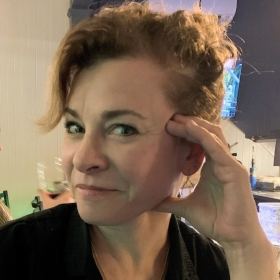
Professor, McGill University
January 2026
You wear many “hats” — scholar, performer, historical consultant, among others. How would you describe your current focus?
I recently submitted two large grant applications. The first was for an initiative to develop research on English-language and bilingual arts and culture in Quebec, and insert that research into wider conversations, which tend to be oriented toward the French-language arts and culture. The goal of this initiative is ultimately to expand the prevailing sense of what “Quebec arts and culture” means.
The second project will explore how theatre creation and play publication in Canada have changed since 1970, especially with the rise of digital and intermedial technologies. It asks where the play “goes” in this new ecosystem and why publication still matters, particularly for minority language communities. I would be looking at English-language playwrights and production in Quebec, with my co-collaborators looking at French outside of Quebec and Indigenous languages across Turtle Island.
How did you start working in the field of Quebec theatre and performance, particularly English-language theatre?
Born in Montreal, I left when I was four. When living in Chicago at 16, I saw Le Rail by the touring Montreal company Carbone 14 and its completely unfamiliar dance- and image-based storytelling made a huge impact on me. I chose to pursue an undergraduate degree in Theatre at McGill University, before completing a PhD in Theatre Studies in the United States and eventually returning to McGill to teach. My research allowed me to sustain my connection to Montreal and think critically about how the performing arts can shape our sense of belonging and relationship to national and local identities.
About 10 years ago, I was invited by a research group of French-speaking theatre historians to contribute to a book on the history of Quebec theatre from 1945 to 2015, where I would investigate the history of English-language drama and theatre in the province. With limited existing scholarship on this, I conducted extensive interviews that uncovered new archival sources, analyses of which were woven through the collectively authored book. A subsequent Fulbright Scholarship allowed me to extend this research to theatre in the “borderlands” between the Eastern Townships and New York State. Lorraine O’Donnell contacted me about this work and connected me with sociolinguistic approaches to minority-language theatre research.
From your perspective, what makes English-language theatre in Quebec distinct within the wider theatre landscape, both in Quebec and in Canada?
Overall, dominant production and acting models have been heavily influenced by the United States and lean toward realism, showing a world that resembles everyday life. Generally speaking, it tends to be quite text-centred: productions often begin with a written script from which everything else develops. French-language theatre in Quebec, by contrast, is historically marked by a turn away from the text, being more visually or physically expressive and based on feeling, atmosphere, and impulsion.
There are also the people working within the theatre scene itself. Something that allows English-language actors to continue living in Montreal, despite the limited number of theatre production opportunities, especially in English, is the abundance of other forms of performance work. For example, Montreal is the Canadian hub for voiceover work and English-language actors are part of that ecosystem, working as voice actors for films, television, and video games.
You were a performer and historical advisor on Cyclorama, a 2022 bilingual collaboration between the Centaur Theatre and the Centre du Théâtre d’Aujourd’hui. How did historical research inform the artistic decisions made in that production?
There were two key ways, the first being that the structure of the play was based around the historical research process. Laurence Dauphinais (Cyclorama creator) asked me and Alexandre Cadieux, my fellow historical advisor, about our process for conducting historical research, which then became the spine of the play. First, Laurence defined the subject - the cultural and linguistic duality of the Montreal theatre scene - before reflecting the other key steps: delimiting the field of study, developing the historical context, consulting primary sources, and interrogating assumptions. These steps are acted out on stage, such as characters consulting primary sources by pulling out maps and photos.
Then there was the historical research itself. Laurence interviewed Alexandre and me about the history of theatre in Montreal, from the 17th century to the present, including flashpoints in linguistic debates, and key figures and events. Some of this information was incorporated into the play itself, and so were some of our research materials: archival documents were used as props and in projections; audio excerpts from interviews with playwrights were played in Act 2. The production design also reflected perceived images of the linguistic groups: the English-language theatre featured real teacups, while the French had a minimal set, only a large screen and projection. The goal was to illuminate these stereotypes, then deconstruct and bridge them.
What role can the creative arts play in exploring, and perhaps helping to reconcile, complex historical narratives?
In Cyclorama, Laurence uses humour to wrestle complex historical narratives, as it makes us think, laugh, and reconsider and resist easy narratives. A great virtue of drama and theatre is that it slows things down; daily life is so busy and we rarely pause to make sense of it. In the dramatic arts, activity becomes intentional action designed to invoke reflection. Sitting in the theatre audience, you’re being shown things that might or might not be real, but it's a time and a place that's set apart and gives us, or encourages us to take, a different perspective on what’s in front of us.
Is there a play, performance, or book you would recommend to better understand English-speaking Quebec through theatre?
A play I would recommend is Lorena Gale’s Angélique, about Marie-Joseph Angélique, an enslaved Black woman in 18th-century Montreal accused of starting the fire that destroyed much of Old Montreal. Gale, a Montrealer, wrote the play in part to explore the historical roots of Blackness in Quebec. It also unfolds across two time periods, drawing a parallel between that time and the racial, sexual, and linguistic dynamics of the present day. The play advances a series of arguments about power, marginality, and belonging, shifting perspective just when you think you understand what you’re seeing and offering another angle to consider.