

Po B. K. Lomami
Compartimental
9 mars – 22 mai, 2026
 Nothing 07. Chlorure de polyvinyle, impression à solvant, acrylique, lumière, aluminium. 6,20 m de long, 60 cm de haut, 15 cm de profondeur. 2025-2026. Photo: Laurence Poirier
À propos de l'exposition
Quelle est l’infrastructure de la compartimentation, et que se passe-t-il lorsque les compartiments s’érodent, se déversent ou s’effondrent ? Partant de cette question, Compartimental trace les architectures physiques et émotionnelles que nous construisons pour vivre avec ce qui nous dépasse. À travers images, sons, données et textes, l’installation explore la compartimentation comme stratégie de partition nécessaire, permettant à la vie de continuer au milieu de la violence, des déplacements et des ruptures héritées ou en cours. Organisée comme des chambres psychiques, la disposition interrompue de l’exposition reflète des histoires interrompues, avec une logique spatiale construite de seuils et de cloisons qui façonnent le passage de l’observation passive à la navigation intentionnelle. Accablés sous la pression accumulée, ces compartiments ne sont pas fixes. Compartimental trace plutôt la tension entre structure et débordement : la rage qui pousse contre le contenant, le deuil qui se diffuse à travers les générations, l’opacité qui résiste à l’extraction.
« Compartiments » dans les vitrines York, depuis l'entrée de la galerie FOFA jusqu'à la sortie sur Mackay Street :
 Œuvres de gauche à droite: Dear Batamu, Dear Wime et Dear Nkuba, photographie, impression sur pellicule, 30" x 80" chacune, 2023. Endling 09 (In presence), photographie, impression jet d'encre sur papier, 60" x 42", 2023. À la mémoire, photographie, poésie, impression sur pellicule, 60" x 108", 2023 . Photo: Laurence Poirier
Après que j'ai perdu trois matriarches successivement dans l'est de la République démocratique du Congo, sans possibilité d'y retourner pour rendre visite et faire mon deuil, la lignée est devenue instable, tant sur le plan matériel qu'immatériel. Ces œuvres témoignent d’une tentative de maintenir des liens, révélant la menace indicible et la réalisation de la perte. Après tant de séparations, de disparitions et de déplacements, que reste-t-il ? Qu’est-ce qui protégera l’avenir contre l’oubli ? Cet espace met à l’épreuve une légitimité incertaine, menacée par la honte et la peur de l’échec. Ici, la compartimentation protège contre l’implosion psychique ; elle partitionne la mémoire, permettant la continuité tout en portant la fracture.
Le poème figurant dans l'œuvre À la mémoire a été initialement publié dans le magazine estuaire, numéro 190 « Adelphes », octobre 2023. Pour plus d'informations, cliquez ici.
 Œuvres de gauche à droite: Nothing 02 (_ _ _ _ _ _ _ _), composition audio-vidéo interactive en stéréo, programmation, full HD, 18 ans, 2023-2025. Nothing 01 (Small Talk), vidéo interactive en temps réel et composition sonore en temps réel, traitement des données en temps réel, programmation, full HD, 2023-2025. Nothing 05 (Load Er), vidéo interactive, full HD, 22 min (loop), 2025. Photo: Laurence Poirier
Il n’existe pas de comptabilité précise et quotidienne du nombre et des noms des personnes assassinées, violées, torturées, exploitées, déplacées ou disparues dans le génocide en cours des millions de personnes dans la République démocratique du Congo. Il n’existe pas de chiffres exacts sur la quantité de minéraux extraits, aucun registre de l’ampleur de l’asservissement, et aucun compte rendu des profits accumulés par leur circulation. Il y a plutôt des estimations approximatives, des prévisions, des extrapolations, des recensements incomplets, des rapports censurés et d’innombrables témoignages individuels qui ne peuvent être agrégés. Comment peut-on mesurer des atrocités de cette ampleur ?
Une source régulière de données fiables provenant de la région est cependant la météo : température, précipitations, vent, pression atmosphérique. La météo est un sujet de conversation quotidienne en Occident. Si nous ne pouvons pas parler de ce qui se passe, peut-être pouvons-nous discuter du climat dans lequel cela se déroule. Alors que j’ordonne des souvenirs fragmentés, les chronologies se fracturent, les explications sont retenues. Ces récits résistent à l’interprétation ; ils refusent la simplification en un récit consommable, comme un bouclier contre la curiosité extractive. Les lacunes et les répétitions contiennent ce qui est trop douloureux, trop dangereux, trop nombreux pour être résolu. Chargées d'effacements, elles conservent l’atmosphère du « genocost ».
 Nothing 07. Chlorure de polyvinyle, impression à solvant, acrylique, lumière, aluminium. 6,20 m de long, 60 cm de haut, 15 cm de profondeur, 2025-2026. Photo: Laurence Poirier
Le génocide et l’écocide ne sont pas des aberrations du progrès, mais son infrastructure cachée. Ce qui est célébré dans le Nord global comme progrès est indissociable de la violence dans la République démocratique du Congo. C’est le côté sombre de la modernité : une téléologie qui désigne l’accumulation comme développement tout en distribuant la mort ailleurs. Parler du « genocost » ne consiste pas simplement à nommer cette atrocité, mais à affronter la logique économique qui soutient et subventionne le progrès, et à exiger sa réinvention à travers des solidarités qui refusent de normaliser le sacrifice des vies et des terres congolaises.
Combien de temps cela prendra-t-il ? Un retard éternel, sans horizon ni fin. Le temps occidental se présente comme solution—plus de temps, toujours plus de temps—alors que le présent reste saturé de souffrances. Le capitalisme extractif rend les communautés sacrifiables, positionnant les personnes comme menacées sur leurs propres terres. Une logique raciste d’extinction est intégrée dans les chaînes d’approvisionnement mondiales. La violence opère de façon infrastructurelle : par la distribution de l’exposition à la mort et à la précarité, la partition des populations en zones de valeur et de sacrifice où certaines vies sont jugées structurellement « inpleurables ». Le deuil est retardé, contenu, édité, poli, rangé.
 Œuvres de gauche à droite: Endling 06 (Brume), impression jet d'encre sur papier, 30" x 60", 2023. Endling 04 (Afropolitan), impression jet d'encre sur papier, 28" x 42", 2023. Collapse, acide polylactique, époxy, 19" x 10", 2026. Endling 10 (Jantelagen), impression jet d'encre sur papier 28" x 42", 2023. Endling 05 (Tropopause) impression jet d'encre sur papier, 33" x 60", 2023. Photo: Laurence Poirier
Cette infrastructure est aussi psychologique. Elle exige calme, gratitude, assimilation, lisibilité, même tout en portant la rupture intergénérationnelle. La fragmentation émerge à la fois comme condition et comme stratégie : une scission entre mémoire et adaptation. Ici, la rage nomme à la fois l’infrastructure et ce qu’elle dissimule ; la démence résiste à la normalisation de la violence ; la contenance (sanity) à la fois une performance requise et une façade nécessaire. Le corps-esprit diasporique est dialectiquement suspendu entre implosion psychique et anesthésie éthique. La compartimentation protège la psyché de l’effondrement. En même temps, elle reflète la fragmentation structurelle imposée par les systèmes extractifs et génocidaires. Comment passer de la compartimentation comme simple survie à une architecture relationnelle où les fragments peuvent dialoguer sans détruire le soi ?
Les espaces arrangés de Compartimental tracent une condition d’appartenance suspendue. J’habite un espace intermédiaire : géographiquement éloigné de la violence, mais psychiquement enchevêtré avec elle. Je porte les après-coups. Je retiens ce qui reste, mais je ne peux le reproduire complètement. Doux comme un « endling ». Le dernier d’une lignée, la figure de l’endling occupe un seuil chargé : à la fois le dernier lien avec un monde et le premier lien fragile vers un autre. Derrière des surfaces scellées, renvoyant un semblant de normalité, la densité s’accumule. Ce qui semble n’être rien contient un surplus : deuil différé, mémoire suspendue. Dans cet espace infrastructurel, ce qui apparaît comme inaction est une forme d’endurance avec des effets différés, lentement libérés.
Dans un contexte qui valorise la cohérence normative et la transparence consommable, Compartimental propose un autre mode : la fragmentation comme protection sans blocage, la rage comme signe de raison. Alors que la survie chronique dépend souvent de l’art délicat du partitionnement, nous pouvons honorer le courage—voire l’inévitabilité—de laisser les compartiments respirer, transpirer et tacher. Il faut faire le deuil des séparations. L’indifférence face au génocide n’est pas soutenable. Entre structure et débordement, l’œuvre demeure avec la difficulté de contenir ce qui ne peut l’être proprement. Il faut faire le deuil des séparations. L’indifférence face au génocide n’est pas soutenable.
Entrevue avec l'artiste (enregistrement audio et transcription en anglais)
(0:00 - 2:13)
Sendy-Loo Emanuelle: Hi, Po.
Po B. K. Lomami: Hi.
SLE: So today we have 4 installations that you've created that we're going to talk about today. So let's start with the first piece.
PBKL: Yes.
SLE: So tell me about the name of the piece and also how it came about for you to create this piece.
PBKL: Yes. So this piece is called À La Memoire. And first, it's a print. It's a print of a small, small photo that I have from my mom. It's like the size of an ID photo. And it's one of the few last photos that my mom took of herself. I mean, it was done, a portrait of her before she left Congo to go to Belgium. And so that photo was starting to get damaged, I scanned it, and then blow it on a very big film. So it's printed on film. And it is transparent so we can see light come through it. And on the top of it, there's a poem that I wrote during a residency in the Place Léopold-Sédar-Senghor in Montreal, next to the University of Montreal, and during a residency with "La poésie partout" and this text, this poem is really about the absence, in particular the absence of the matriarchs in my family, the absence because of distance and distance in time and distance in space, but also because they passed away one after another in a short period of time. So it's an homage to them.
(2:13 - 6:57)
SLE: We can see also three images of three women that is very, very light. we almost cannot see them. Can you tell a bit more about this piece?
PBKL: So these are the matriarchs I was talking about. They are my maternal grandmother, my aunt, the big sister of my mother, so the eldest in her family. And then my grandmother on my father's side. And the same way they are printed on film, but I wanted to play with this idea of being present and being absent at the same time. So depending on how we place our body in the space, the image became more clear or more blurry. From a certain distance, it's totally gray. And when we come in front or move around, it becomes more clear and we can see the shapes and the contrast. That allows us to see them. So this is also the idea with intimacy, because it's intimate pictures for me, and how to show this grief that you have for people that you didn't grow up with, that you didn't have a day-to-day relationship, sometimes not even communication anymore, but still having an impact on your life by their presence, existence, and also the action in the past, informing the action that other members of the family do today. So it's a way to have them in the space without envying a sense of voyeurism towards them.
SLE: And we see in between these pieces, there is an image of you wrapped in some type of fabric foil with different lights. Can you explain what was the concept behind this image?
PBKL: Yeah, so initially, I am a performance artist. But coming in academia, I couldn't perform the way I used to perform. So I moved towards other mediums and see what they can do in terms of performance, in relation to performance, even if it's different. And in this photo, I was working in a series called Endling, and I was interested in what the image does in comparison or in relationship dialogue with the performance. And I was thinking about the archive. What's the archival performance? What's the documentation of performance? And I wanted to have something that still talk about the performance with that being the performance itself. And I revisited different acts of my performances dealing with grief and trying to restage them based on the memory, the sensation, the dialogue, the collective experience that those performances created.
And so in this photo, I stand wrapped in aluminum foil which is an act that I do in this performance called aksanti 33 Part One. And I have this huge stick, like wooden stick that is actually a spatula, a wooden spatula, also covered in foil. And this is a spatula that I carved for this performance because in my memory, my mom had a spatula with which she was cooking fufu, which is a dish. And it was a big spatula. And my memory as a little, little child is a spatula was my size. My mother still had this spatula. And this spatula, actually, my grandmother, her mother, gave it to her right before she left Congo. So it's something that was passed down and she arrived in Belgium with it and she still has it today.
And from this memory as a childhood, I carved this spatula with my adult size. So it was still my size as in my memory, thinking about how to archive sensation and experience. And I cook with that gigantic spatula, a dish that my mom used to do to me and my grandmother used to do for her children. And then I never did myself because why would I do this? My mom does it better.
(6:57 - 8:38)
PBKL: And so I'm wearing this aluminum foil, hiding myself because I'm in grief and also I don't want to be exposed, and I'm having this spatula that serves me almost like as a help to walk with the weight of the pain. And I'm wearing a mask that is in plastic and transparent and the mask is actually my own face. So I'm wearing my own face, a face in a natural state that's hiding the face in pain behind, wearing my own face and having in a coif, a head wrap, also in aluminium foil. And I'm like standing on the sea of transparent plastic that looks like actually a body of water. And I'm surrounded by three massive lights, spotlights for stage, and those lights are representing the presence of the three matriarchs.
SLE: Thank you. So now we move to the other section. So we can hear your voice, and there's actually 3 components that I see in the space here. One, the first one that we are going to talk about is the screen where there's different images, videos of different components that you filmed. Can you explain to us a bit how it came about and what does it portray?
(8:38 - 10:52)
PBKL: So this is a silent video, this one. And it's composed of different footage, some of like DIY made by myself and some are archives and sometimes they're intertwined or layered on each other. And the idea that came first was I have all these objects from those performances that I've done. A lot about my diasporic position, the history of my family that I'm trying to connect to or to get access to, and also the history of colonialism between Belgium and the Democratic Republic of the Congo because I was born and raised in Belgium. And in this video, I brought all these objects from the past performances and tried to show the liveliness that they have for me after I perform with them.
They're not empty, they're not neutral, they're charged with experiences from the past. But as a performance artist, those objects are not art pieces by themselves. They're like objects become artifacts of the performance. And I can't just keep collecting objects from performances that I will not do it again, but it's hard to let them go at the same time because they're connected to those stories now. And so in this video, I wanted to talk about the sensation of suffocation that I have when I try to approach difficult histories and what the objects as a performance, artists helped me to do through those processes and navigations and what it is to put them in dialogue with the archives. So I'm using fabric that I use in my performances that is used in the video as layers, as structures of the image from archive that I use.
(10:52 - 12:41)
For example, right now, as we look at it, is an archive from happy times and clubs in Congo about trends with music and dance in the 60s and its also to show this always like coexistence between culture, collective joy, collective traditions, full scope of life that is coexistent with destruction, genocide, ecocide, colonial violence, imperialism, extraction, and how it's part of the same world, and how it creates in me sometimes this sensation of suffocation between wanting to connect and be there, and also the fear of what can also happen at the same time. So in this work, I'm really working with all those materials and trying to talk about, maybe not talk about, but make feel what I experience and what a lot of people in diaspora experience without saying any words, without writing any words, and how we can get through this topic about heaviness and sensation of suffocation. and how it might look like because it doesn't always look dark. The same way depression doesn't always look dark. You can have people who look happy around you, but are deeply depressed inside. And I wanted to be able to show these states. Yeah.
(12:41 - 14:07)
SLE: Interesting. Very interesting. And see that it connects us with the big middle piece where we see different waves and different static movements and moves in waves and we think about, we try not to see what it conveys but you have a specific meaning for this piece that we may not see from a first glance. Yes. So tell me a bit about this piece.
PBKL: So this piece is called Small Talk and It's a little bit the cynicism and pettiness in me coming from my own my position that, okay, if we can't talk about the genocost happening in the Congo, maybe we can talk about the weather under which is happening because the weather wherever we are in Canada or Quebec or in Belgium, it's part of our small talk. We always talk about the bad weather, the good weather, mostly bad weather in Belgium, as a way to have this small talk connection. And in my mind, like my thoughts, it's often about what's going on in the east of the Congo.
(14:07 - 16:25)
PBKL: And so that's my way to talk about what's going on, by talking about the weather in that part of the world. When I say genocost, the genocost is a specific term to describe and ask for accountability for what's happening in the Congo. So it's the genocide for economic gain. That's what the genocost is.
And we talk about millions and millions and millions of people being killed. We talk about in months a number of people being raped and tortured and displaced and enslaved and exploited in mines and fields.
And so this piece is, I make a code and I make requests to have weather data from different parts of the east of the Congo and also north and some south that are targeted by the genocost. And I receive all this data and then through my algorithm I make an extraction of of this information, this data information. And when it's really like now, like how we hear, it's become like granular and it could be drops, so it could be like drops in suspension in the air.
When it's a clear sky, it becomes more silky. Sometimes it looks like smoke to also evoke the forest being burned to have extraction happening. So that part is like the part of the ecocide of the whole system.
And before I used to work with data from the past, but for here this iteration of the piece, I'm working only with forecasts. The idea is that the data from the past, they will not change, but the forecasts change every hour. And so there's still this little hope that things could change in the future. that I wanted to work with. So right now we have the weather of Rubaiya on April 23rd, so in the future at 11pm in the night.
(16:25 - 18:44)
SLE: We hear your voice.
PBKL: Yes.
SLE: And you're naming different numbers. Why?
PBKL: So, there's a lot of reports and testimonies and articles and stories and messages about what's happening in the east of the Congo, but there's not a registry about the number of people being killed, the number of women and children being raped, etc. And so I was thinking if we had a registry with all the people being killed in the genocost, ordered by alphabetic order, the order within which it will be killed would be a random number. And so what this piece is trying to do is to not count, but name every victim.
But because I don't have a registry with all the names, I try to say those numbers as names. So I say a number. And I breathe in and breathe out as a way to witness and to hold space for every number name. And because also even the estimation is not fixed in the sense that there's a lot of discourse about it, which means that the number we hear a lot about 5.4 million or 6 million people killed is a number that is from 2008. And it's kind of like the estimation, official estimation got stuck at 6 million, like people stopped counting because it's so much. And we are in 2026. And so I'm working with those potential numbers. Some estimations go as far as 11 million, 16 million. And so I'm trying to get to those number names that are not counted for too.
(18:44 - 19:45)
PBKL: And this piece, if we wanted her to go over all the number names, it will require from someone to stand in front of it 24-7 for 13 years. And the idea is to also give a sense of the scope of the suffering and the damage of the genocost, because how can we even compute millions with our little brains? And the role between here, the three pieces, are interactive too, which means that they're only activated if someone is there to witness them. So this is we actually even take longer because if there's nobody in front of it, stops and we stay quiet.
(19:45 - 20:23)
SLE: It's very powerful and I think time is needed to really fully understand what you've created here. Thank you for the description of the work. And now we move on to the third space.
(20:23 - 22:31)
SLE: So now we move on to the third space. And we have a piece here that is constructed and there's words written inside of it that are lightly noticeable depending on where we stand. And you were talking a bit about genocost and that's what we see here in progress, genocost in progress. Can you explain to us a bit What was the intention for this piece?
PBKL: Yes. So the thing with the genocost, why, I mean, the genocost has been happening for 30 years. So we start, we count this genocaust since 1996, which was after the genocide in Rwanda. And that was like the genocaust started as a consequence of the genocide in Rwanda. And there's really difficulties talking about what's happening in the Congo. First of all, in Belgium where I grew up, because it's hard to talk about the Congo by itself because of the history, the colonial history, and a lot of denial still happening about the harm caused in the Congo from colonization, from Leopold II to the state of Belgium to still the problematic relationship happening between the two countries.
And the other reason why it's difficult to talk about it is because since it's like, since other countries are involved also in these genocost, it's hard for international community to point out how a country that was a victim of a genocide can also be involved in another genocide today, in the case of Rwanda, for example.
(22:31 - 24:23)
PBKL: So it becomes hard to talk about what is happening to us because other things happened to other people before. And so this impossibility to talk about the genocost, I really wanted to give it form and shape and also visibility and invisibility. And in this space, I want to talk about how progress is a result also of the genocost, that the genocost is a cost, a sacrifice that we accept for progress, which is all the extraction that we are doing today that we need for our phones, for our computer, for our electric vehicle, for all kind of industrial processes needs minerals that are extracted in the Congo, in particular cobalt and coltan are two big ones, because the majority of the sources of those minerals are in the soil of the Congo.
And all these discussions about turning green and progress is actually not neutral. It involves people being killed, raped, displaced, exploited, enslaved. And we decided that it's okay to sacrifice Congolese people for that. So with the difficulty to talk about this and also because we're so an institution and it has been difficult to talk about genocide in school, in academia, in public space, the consequences from wanting to mobilize what is happening, I wanted to bring conversation about genocide in the space in a way that it can't be removed.
(24:23 - 26:03)
PBKL: So I create these kind of billboards or light box that is 6 meter long and only 6 inches deep and it's about maybe 100 feet high and no 100 inches high and behind is a text and then it's covered by specific material that make that text disappear depending on how we move. So if we enter the hallway that leads to the gallery, the billboard is like blank. And as we move along, letters are showing up. revealing the message behind and this message connect progress and genocost.
And the only moment you can actually see the whole message together, the best, is next to the elevator that gets you to get to the higher levels of the building. So it means that everybody getting out of the building from this place or coming to the building from this place, as they get in, the message will reveal themselves and they have to move through the day with the message or leave the institution with this message and making sure that this message is always there. And at the same time, if you just walk around and not pay attention, you don't see it at all.
(26:03 - 26:44)
SLE: I really find it interesting that you selected the space itself where it would be located so that when you come out of the elevator, you would see the message itself and as you move away, may decide what you do with this message and how it disappears. Because it's part of, like you were mentioning, the genocide cost. The genocost is a way of creating progress, like you were mentioning, but at what cost? At human cost. But it stays in your mind and what after that, what people can do with this message is up to them.
(26:44 - 27:45)
PBKL: Yes. And I made this piece specifically for the vitrine of FOFA, this section. And what I was about to say? I was about to say something.
SLE: You made this piece specifically for this space. Why this space?
PBKL: Yes, I made it specifically for this space because I want it to look like it could be part of all the institutional message. It could look like message boards that we have around. It looks very industrial. It's not using traditional mediums of art. It's actually very much material coming from industry and construction that is used and marketing that is used for this space.
(27:45 - 28:33)
SLE: And now we move to the last space. And we have four images that are, two are the same size and the other one is, the two others are smaller. And there's another sculpture that is on the ceiling from the wall to the ceiling. So it's really embedded, sort of placed, I would say, placed between the wall and the ceiling. And I think we see your face with your two hands that are on your face.
PBKL: Yeah.
SLE: Can you tell a bit more about this space? Because I think we see a portion of your face or your body. So what did you want to convey with this last piece here?
(28:33 - 30:03)
PBKL: This section is really about grief and what you're allowed to reveal as grief and what you're allowed to grieve. I feel that what is happening with the genocost, the fact that we let that happen for more than 30 years is a message to us Congolese, in Congo, on the African continent, in the diaspora that our lives are not grievable. Because if we mount to millions and millions and millions, what message does it say to us?
And so the idea was really to talk about the fact that we are not allowed to grieve or that those lives are considered as not grievable, but also at the same time how what our lives could have been is not grievable to because in my case, for example, me and my little brothers, we don't go to visit our family there because of the situation. So our diasporic situation and family situation is heavily impacted by the genocost and almost in the sense that if people get out of the region, they don't come back. So it's only one direction.
(30:03 - 31:39)
PBKL: So what it means about connection to the lands and waters from there, connection to family and community, ancestral land, ancestral traditions, knowing who you are, where you come from, on the top of the people being killed and tortured and enslaved. It's like this connection is not grievable. And I was really thinking about this idea that even grief is one of these emotions that is expected to be a noble one, just like this is a thing that you're allowed to feel because this is dead, so it's serious, but at the same time it's expected that you are respectable in your grief.
And what it means between, you know, these expectation to be respectable in your grief when I think about the woman in my family, but also at the same time how the genocost is not grievable. So the consequence of me, for example, not being able to know those people, go to the funerals, the reason why is not grievable itself.
And so in this piece, we see a lot of my face in the two small pictures that are really white and washed out. And the idea is to have to show this face that is not totally shown, but is also neutral. So one picture, for example, is actually not a picture of my face, but it's a picture with a game of light moving. And what we are actually photographing is the mask that I wear in the first picture we saw at the beginning.
(31:39 - 32:40)
PBKL: And this one, this other picture that is really blurry and there's some point we can sense is maybe a mouth and a nose. It's a picture behind layers of veil. So it's hiding the expression, it's just showing the features that are nodding neutral.
And on the two sides, the two bigger and darker pictures also about hiding pain and expression. This one is linked to the fact that I often learn about death in my bathroom when I wake up and then I check my phone. And I have this tendency to put my hands on my face to almost contain the emotion. And with my disability, I can't put my left hand on my face, so I use my right hand to put my left hand on my face.
(32:40 - 33:45)
PBKL: So it's like this connection. And the final one, I mean, the first one in the vitrine is also feeling contained in a box and also wrapped in this aluminium foil that is become like almost like separating from the smoke of the emotion and the information. And so it's like emotion contained in a space.
And finally, the sculpture up there is really trying to show how I have to make this emotion fit somewhere, not taking too much space. But this emotion is also big, so that's why it's bigger than my actual size. But it's still like stuck in a space where It doesn't take full space. It's just like hidden there. And people might not notice it. It's only if they come closer to the vitrine that they notice that actually this sculpture is there.
(33:45 - 35:36)
SLE: So you made your hands and your face bigger. Okay. Very interesting. And how is the exhibit? All of those piece, did you, I see that you gave a name to this project.
PBKL: Yeah. Yes.
SLE: Can you tell us a bit more about why did you choose this name and what is the name itself?
PBKL: So the name of the exhibition is Compartmental and it's mostly pieces from two series. One series is named Endling. Endling, I see it as a person, an instance that is the end of a line or the end of something, of a genealogy. And nothing I work with this idea of nothingness that you, this idea of void or the silence of things you can talk about, but also the nothingness in sense of like what can be contained in the structure. So it's like surplus of it and so it looks like nothing, but it's actually way more that can be contained and explained.
And the exhibition is named Compartmental as a way to have those sections that are like physical space, different physical space, also sections of time, and also psychologically how we section sometimes existence to be able to move on every day as a as a way to still do, but also not forget at the same time.
(35:36 - 36:05)
SLE: athat is so true. Sometimes we do compartmental things in order to go through life. And depending on what we go through, and sometimes just having those separated space can permit us to move on or to move forward or to move back.
PBKL: Yes.
SLE: Or to just be, yeah, just to. Thank you so much, Po, for explaining those four pieces that are very complex and very deep. Thank you.
PBKL:Thank you, Sendy-Loo.
Conversation avec Po B. K. Lomami & eunice bélidor (bilingue)
Exhibition views
 Signalétique murale de l'exposition, réalisée à partir d'un miroir recyclé et de peinture blanche par Joé Côté-Rancourt. Photo: Laurence Poirier
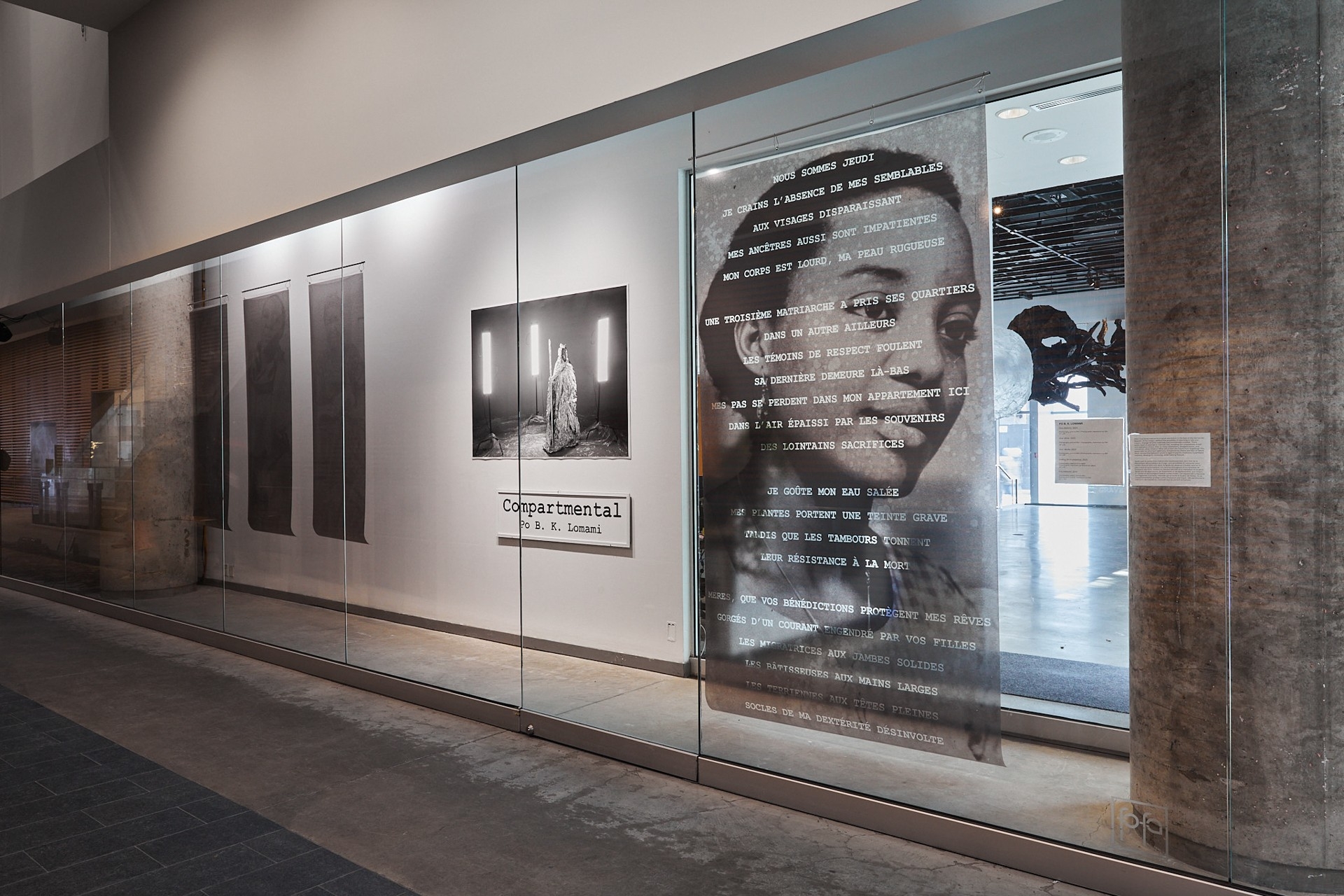 Œuvres, de gauche à droite : Dear Batamu, Dear Wime et Dear Nkuba, photographie, tirage sur pellicule, 76 cm × 203 cm chacune, 2023. Endling 09 (In presence), photographie, impression jet d’encre sur papier, 152 cm x 107 cm, 2023. À la mémoire, photographie, poésie, impression sur pellicule, 152 cm x 274 cm, 2023. Photo : Laurence Poirier
![Gros plan sur le poème figurant sur l'œuvre « À la mémoire ». Le texte dit en français : [...] dans un autre ailleurs. Les témoins de respect foulent sa dernière demeure, là-bas [...]](/content/concordia/en/finearts/about/galleries-venues/galerie-fofa/expositions/2026/po-b-k-lomami/_jcr_content/content-main/grid_container_103710027/grid-container-parsys/carousel_parsys/parsys-carousel-2/image.img.jpg/1777312046396.jpg) À la mémoire . Poème disponible dans le magazine estuaire, volume 190. Photo: Laurence Poirier
À la mémoire . Poème disponible dans le magazine estuaire, volume 190. Photo: Laurence Poirier
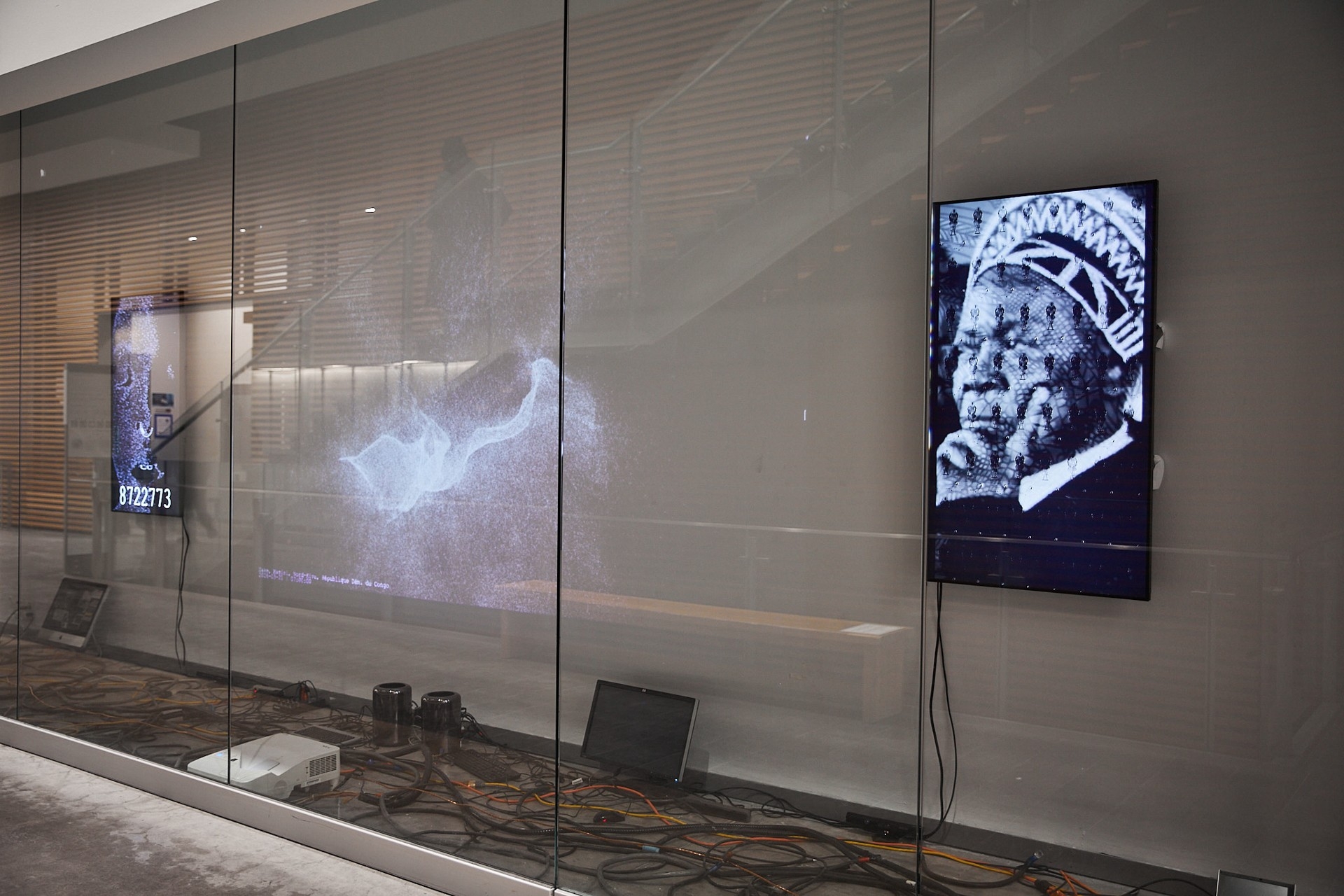 Œuvres de gauche à droite : Nothing 02 (_ _ _ _ _ _ _ _), composition audiovisuelle stéréo interactive, programmation, Full HD, 18 ans, 2023-2025. Nothing 01 (Small Talk), composition interactive vidéo et sonore en temps réel, traitement des données en temps réel, programmation, Full HD, 2023-2025. Nothing 05 (Load Er), vidéo interactive. Full HD, 22 min (boucle), 2025. Photo : Laurence Poirier
 Nothing 01 (Small Talk), vidéo interactive en temps réel et composition sonore en temps réel, traitement des données en temps réel, programmation, Full HD, 2023-2025. Photo : Laurence Poirier
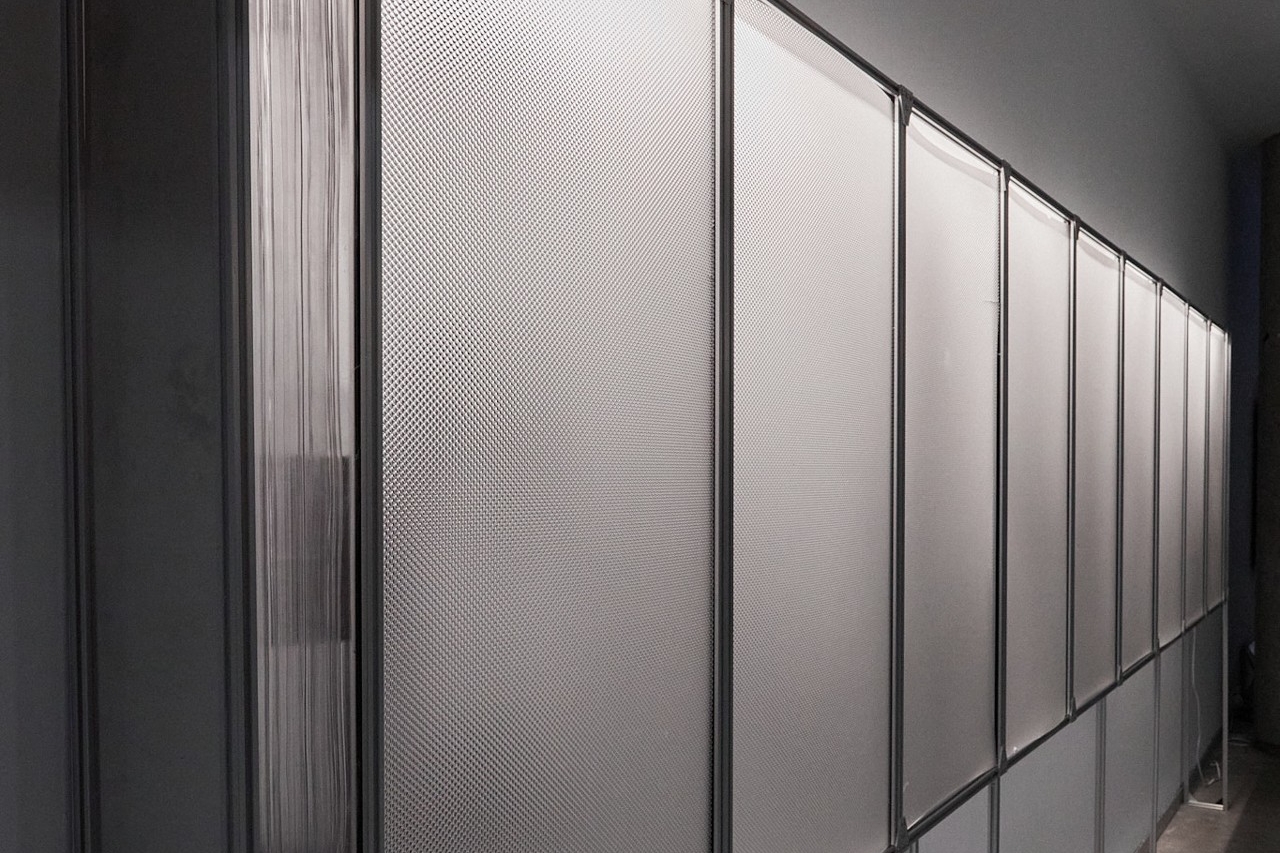 Nothing 07. Chlorure de polyvinyle, impression à solvant, acrylique, lumière, aluminium. 6,2 m de long, 61 cm de haut, 15 cm de profondeur. 2025-2026. Photo : Laurence Poirier
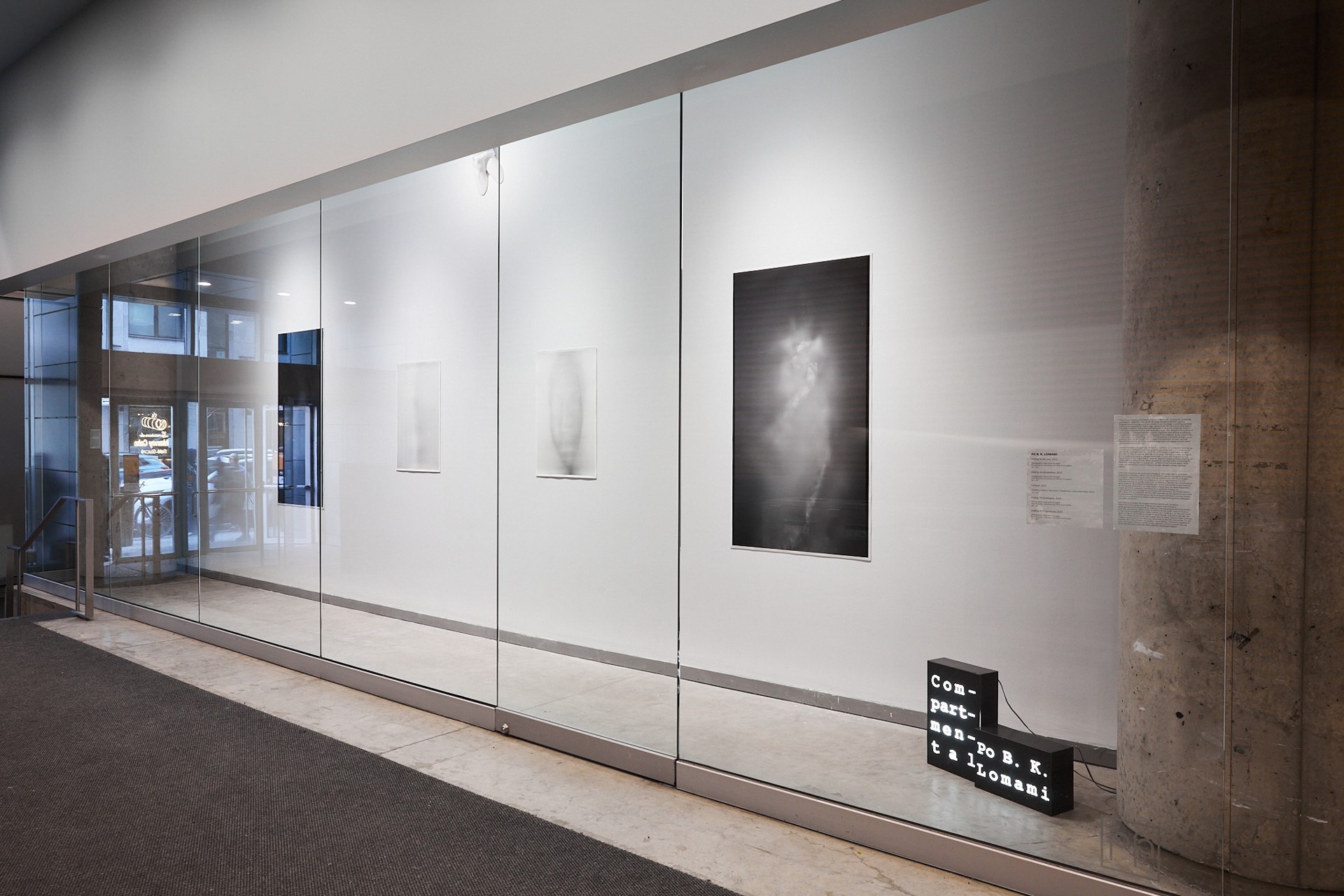 De gauche à droite : Endling 06 (Brume), impression jet d'encre sur papier, 76,2 cm x 152,4 cm, 2023. Endling 04 (Afropolitan), impression jet d'encre sur papier, 71,1 cm x 106,7 cm, 2023. Collapse, acide polylactique, époxy, 48 cm x 25 cm, 2026. Endling 10 (Jantelagen), impression jet d'encre sur papier, 71 cm x 107 cm, 2023. Endling 05 (Tropopause) impression jet d'encre sur papier, 83,8 cm x 152,4 cm, 2023. Photo : Laurence Poirier
 Signalétique de l'exposition réalisée par Joé Côté-Rancourt. Photo : Laurence Poirier
Biographie
Po B. K. Lomami (Pauline Batamu Kasiwa Lomami) est artiste-chercheure indisciplinaire et enseignante. Issue de la diaspora congolaise en Belgique, iel vit actuellement à Tiohtià:ke/Mooniyang/Montréal depuis 2017. Explorant la rage et l'échec, la pratique artistique de Lomami s'articule autour du déplacement du travail, du devenir de sa subjectivité et des futurs collectifs possibles.
S’intéressant au processus entre l’action et l’inaction, iel interroge les gens, les institutions et iel-même à travers l'affection, la force, l'absurde, le quotidien et les données. Iel construit des super-archives qui ne fixent pas le moment de l’action dans un document traité mais qui à la place prennent la forme d’œuvres installatives, vidéo, sonores et électroniques qui explorent la super-performativité comme une opportunité de redevenir sensible aux données et de sentir quelqu’un ou quelque chose qui n’est pas ou plus là.
Son travail a été présenté en Belgique, en Suède, à New York et au Canada et ses textes ont été publiés dans des publications françaises, québécoises et panafricaines.
Visitez l'Instagram de Po B. K. Lomami

 Collapse, acide polylactique, époxy, 19" x 10", 2026. Photo: Laurence Poirier
 Endling 09 (In presence), photographie, impression jet d'encre sur papier, 152,4 cm x 106,7 cm, 2023. Signalétique murale de l'exposition réalisée à partir d'un miroir recyclé et de peinture blanche par Joé Côté-Rancourt. Photo : Laurence Poirier