


Letters for cultivating home
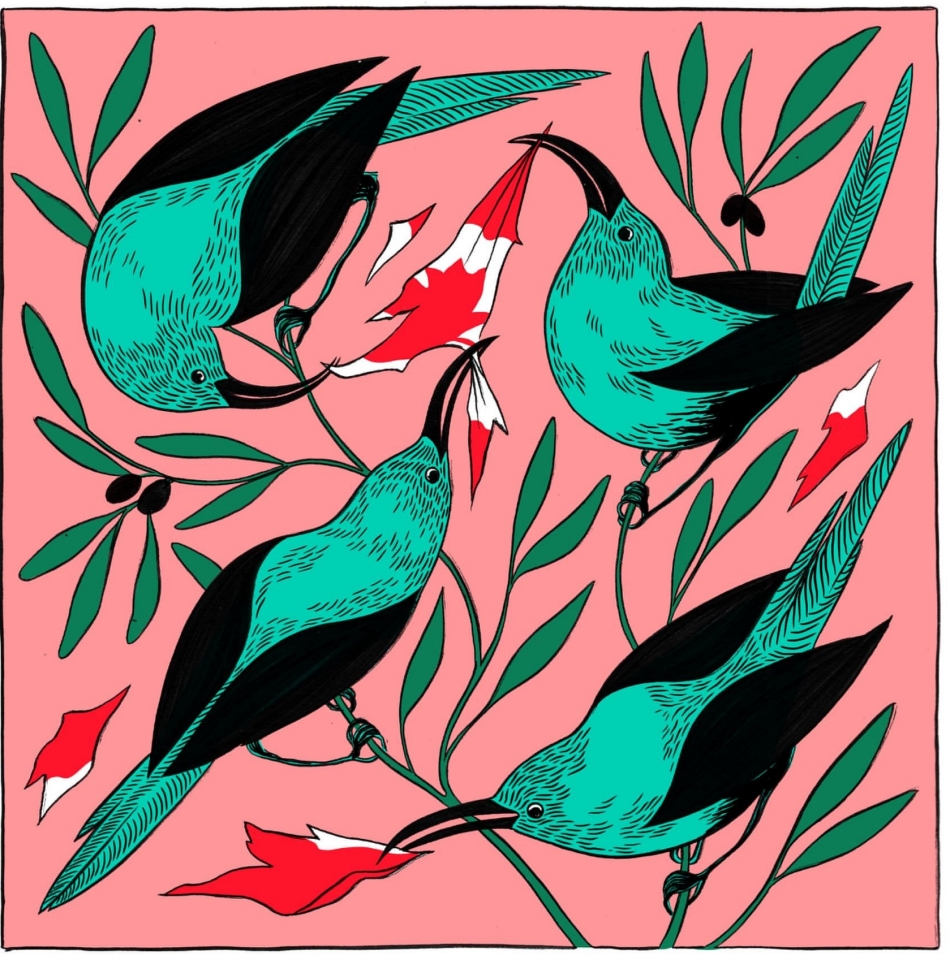 Artwork by Lee Lai (IG: @_leelai)
To cultivate the land is to tend the soil, establish infrastructure, and sustain life. While cultivation can be physical, it can also be metaphorical. Cultivating home may be as simple as curating communication and planting the seeds needed to grow your community. To cultivate the land is to transform an unfamiliar environment into home, even if that is a second home, and surrender to the comfort of knowing and being known. These pieces are indicative of people finding their footing, cultivating an ecosystem of love and support in a place foreign—whether that be a few streets down or across the globe—and discovering the intricacies of their routine or landmarks that trigger nostalgia and gratitude.
In this special edition of the SHIFT Journal, we invited submissions from our community that answered the questions: what does it mean to love a place that's imperfect, or even antagonistic? What do we yearn for, wish for, or fight for in lands that we've left or still inhabit? Read more of our love letters.
Desire in the City
This is a love letter to the city of my rebirth, the city my brother passed me the keys to as a wide-eyed teen, soaking in the feeling, the hum in my bones, of NDG, of Saint Henri, of the Plateau and Parc Extension. The Mile End apartment where I slept in a hammock excited for my niece to be born, the venerable 80 bus rumbling by. The texture of the viaduct, Van Horne opens up, a pulsing ventricle fondly gathering detritus in its recesses, cholesterol, confetti, glitter on a birthday card. My city beats in the closed down venues and the open ones too, be they in a loft or a basement or an old concert hall. The tenuous grip of a wobbly tire and the feeling of total freedom, riding a bicycle home at 3am on a summer night.
And this city is not this city without its people, a rotating cast of recurring roles and walk ons too, each with our own flavour, our own joy in this veritable potluck of connection and commotion that unfolds metastatically, each sidewalk and park an extension of the same labyrinthine, open air living room. This city is a handflailing conversation between the languages of imposition and of raucous desire, the paths of inquiry and curiosity and experimentation that lead us into each other, unknown, a never-ending dance of wishing or willing this dreamscape into reality and finding beauty in its extensive flaws, an ever-accelerating reproduction of plot holes waiting to absorb us into the very surface of our shared story with skinned knees and couple of loose teeth
- Nico Contreras
The Comfort of the Third
What I called home is not an address,
Not permanent, but a pause between doors,
The place where your shoulders finally drop,
And you breathe a sigh of relief,
Saying “this is where I can be myself,”
This so-called safe haven space.
The place smells like toasted crisp bread at dusk,
Like fresh detergent clinging to warm soft cotton,
Where rain dragged in on borrowed soggy shoes.
As air swiftly knows your name,
And never asks you to spell it.
Light shines, it settles here differently.
Pleasant lamps hum low like they’re keeping a secret,
Sunlight pools on the floor, laying the beaming heat,
As if it plans to stay.
Nothing performs,
Where everything belongs.
You listen it first:
The click of a familiar light switch,
The tick of an old-fashioned analog clock hung on the wall,
Pipes knocking once in greeting,
Laughter and chatters leaking through thin walls,
And someone else’s music becomes yours by accident.
Texture remembers you, vividly, feeling it,
Where the cozy couch shaped to your body,
The chipped mug warming your palms,
Wood smoothed by years of pacing thoughts.
Even the creaking floor knows,
How you walk when you’re tired.
Taste lives here, too,
Salt, Crunchy, and Umami from shared meals,
Midnight cold delicate sweetness straight from the fridge,
The metallic comfort of tap water, sipping,
At 3:00 AM when sleep won’t come as my thoughts wander.
Home is where silence isn’t empty.
It sits with you, with us, with memories etched dear to our hearts.
It listens, cries, and is there for you in times of need.
It lets you be unremarkable and still whole.
Not work,
Not spectacle,
Not transit or travel.
This place called a third place,
Where you are neither becoming,
Nor proving,
Just existing,
In the soft middle,
Of being known.
- Kim-Britney Vu
Between Two Plateaus
To the land that holds me now, and the hills that hold my history,
I come from Islamabad, a city where the air carries the scent of pine needles and the damp earth of the Margalla Hills after a monsoon rain. I am a child of a Greek architect’s Sector grids and wide, quiet boulevards, raised in a place that felt like a conversation between the mountains and the sky, the colonizer and the colonized.
Now, I find myself on the island of Tiohtià:ke. My life here is a map of shifting postcodes, moving through the colourful, overpriced staircases of the Plateau to the industrial, gentrified brick of Saint-Henri. But I often find myself pulled toward Parc-Ex, chasing a specific geometry of belonging. In the merging of scents there — frying spices, incense, and rain on warm, cracked pavement — the border between the Potohar plateau and the Island of Tiohtià:ke thins. For a second, I am in two homes at once.
As I walk these streets, I recognize that my presence is part of a complex map. I am an immigrant from a land shaped by Partition, settling on land that was never ceded by the Kanien’kehá:ka Nation. To love this place through its hostility — the biting wind off the St. Lawrence or the systemic walls that keep us apart — is to first acknowledge whose feet have walked here for millennia.
Braided love; the realization that the fight for justice to farmers and the keepers of the land in Pakistan is kin to the fight for sovereignty here. We build emotional infrastructure in the pockets of home we create when the city feels cold: in community fridges, in the chai shared in drafty kitchens, in attending protests together, and in the simple, radical act of caring for a neighbour in a language (Urdu, Punjabi, broken French?) the state doesn’t prioritize.
The path forward is a commitment to being a good relative to this soil. I love this home — even when it feels antagonistic — by honouring its true keepers and by planting the resilience I brought from the Margallas into the potholes of the Montréal roads and the tip of Mount Royal. I am building a home that isn't just a house, but a promise: to leave this land more just than I found it.
- Zahra Haider
My recent travel to my birthplace sprung so many complex thoughts in me.
Landing in Barishal in Bangladesh from Montreal’s frigid cold and seeing luxuriant, verdant and prosperous greenery instead of shades of white was mind boggling. Montreal gave me my many different identities, shaped me into who I am and it’s where I felt I was standing between two pirogues, never stable, standing still but not secure. How that feeling shifted and I felt a bolt of life that sprang through me as if I have always known this unknown place. I felt roots birthing, roots that I never knew existed. The essence of my existence and experience just came to being and awoke in me. I felt like spring blooming. My body is here but my heart is left behind.
I felt I have found my brethren. I was in a changed environment which exists in books but here it was in practice. The concept of communal is practiced in daily life. Welfare checks on the elders, care for the unprivileged even if these weren’t the ultrarich. It wasn't a show but an inner duty. An essential part of being. Sharing the harvest with your neighbours, just calling them to sit with you to have a sip of chai. Collecting coconuts from your trees, remembering that it’s your elderly neighbour that planted and offering him and his family without them asking. The concept of communal was everywhere. My heart felt at ease and at home. Where sharing and care was part of the norm even between “enemies”. Disputes over land would happen then suddenly they would sit together and try to resolve it with the village elders. No need for fancy degrees on mediation just having the patience to listen and talk. I felt at home far from the chaos of learned material.
My body is here but my heart is left behind.
- Nafija Rahman