


Ateş Balsoy is a 3rd year undergraduate student at Concordia University specializing in Urban Planning and minoring in Human Environment at the Department of Geography, Planning, and Environment. His research interests include segregation, displacement, urban public policy, and social aspects of urban spaces. Before being the Research and Advocacy Program Fellow of Welcome Haven under the SHIFT Centre for Social Transformation, he worked at Welcome Haven in different positions from communication and outreach to data visualization since January 2024. During this time, he completed a research project on how the spatial locations of the federal temporary accommodation sites contribute to the urban experiences of asylum seekers. When not working on his research or studying for that next exam; you can find him doing ceramics, writing short stories, or scrapbooking.
Lessons from Pro-Migrant Organizing in Quebec
by Ateş Balsoy
This piece was selected as part of SHIFT's special edition issue Research by and for Community (September 2026), which invited pieces from our community related to explore what it would mean to have research and learning environments that better reward relationship-building, curiosity, co-inquiry, and shared power. This piece in particular was written by one of the 2025-26 SHIFT Research & Advocacy Fellows about their community-led research project.
As one of the SHIFT Research and Advocacy Program Fellows , my mandate was to work with Welcome Haven, a participatory-research project, to analyze the policy and power landscape around family reunification legislation in Quebec and study recent policy shifts. The research I conducted was complementary to Welcome Haven’s broader goal of creating a strategy to advocate for shortened timelines for family reunification for protected persons. To be able to contest these recent policy shifts and build a strategy to mobilize, it is essential to situate them in relation to previous pro-migrant organizing efforts in Quebec. This article will focus on pro-migrant organizing in Quebec during-and-post-COVID lockdown with an emphasis on the Status for All campaign and the campaign for Asylum with Dignity and their significance for future advocacy efforts for shortened timelines for family reunification for protected persons.
Political Climate Behind the Start of the Campaign
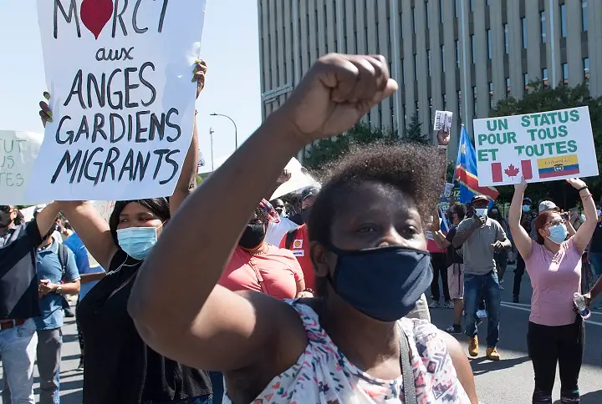
The COVID-19 pandemic exposed how dependent Quebec’s ways of maintaining daily life are to the labor of immigrant workers. Yet, many of the frontline workers during the lockdown performing dangerous work lacked access to social support due to being asylum seekers and immigrants with precarious status (Stein, 2026). Such offerings were only for citizens and permanent residents of Canada. Despite this systemic exclusion from healthcare protections, the same population was described as “guardian angels” and “heroic workers” in the media by the Premier of Quebec at the time, François Legault, (Macpherson, 2020) which demonstrated a political contradiction: if immigrant workers were essential enough to risk their lives during the pandemic, why were they simultaneously treated as structurally disposable by the government? The first protests demanding regularization emerged from Montreal’s Haitian community, who organized a car caravan demonstration in front of then prime minister Justin Trudeau’s, constituency office in Montreal, which became the first of many to come.
The recent history in the province exposes a system that creates exclusions and exceptions for immigrants while depending on them, and a state authority that creates a division in society through immigration status.
Transforming Individual Cases Into a Collective Demand
Even though the campaign succeeded in connecting the demand for regularization with Quebec’s healthcare and other service systems and bringing wide-spread media coverage, without a clear collective demand, the wins of the campaign were small. The government introduced The Guardian Angels Program to provide permanent residency to asylum seekers working frontline jobs. However, the program ended up being beneficial only for a limited number of asylum seekers as both workers in non-hospital settings and people whose immigration status did not satisfy program requirements were not allowed to participate (Stein & Henaway, 2025). According to this policy, asylum seekers were only “worthy” of permanent residence when they worked in the “right” occupation, during the “right” period, under the “right” immigration category. What drove the movement going forward was the hypocrisy between immigrants being required to prove their usefulness to receive access to services, while governments can simply use immigration status as a reason to not provide access. Consequently, Quebec’s immigration system that makes immigration status the basis for distributing rights and security led to the broader demand for the Status for All campaign while highlighting that exposing the cracks in the immigration system should be complemented with transforming individual cases into a collective demand.
Clearly Identifying Leverage Points for Demands
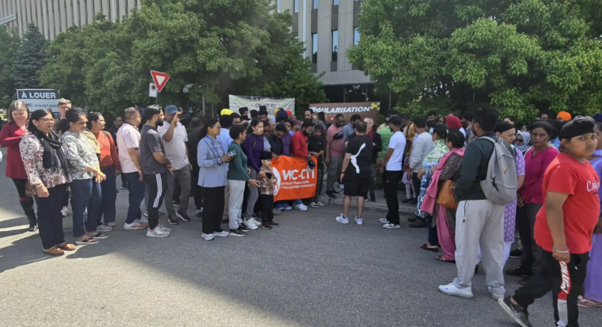
The Canadian Council for Refugees’ National Plan/Campaign for Asylum with Dignity drew from the learnings of the Status for All campaign: an immigration system that grants rights based on economic usefulness would also withdraw those rights from those considered “less useful”; consequently, the campaign presented asylum reception as a question of public infrastructure, dignity, and government responsibility. By demanding that institutions be reorganized, the campaign challenged the provincial government’s politics of abandonment and practice of bordering through status (Gagnon, 2020).
The campaign had clearly defined demands:
- establishing reception centers,
- providing sustained federal funding for short-term and transitional housing,
- expanding eligibility for Settlement Services,
- ensuring that adequate legal aid coverage is available for refugee claimants, and
- streamlining the asylum application and determination process.
These demands argued for existing community-based infrastructure to be scaled up and existing governmental services to be made available for all (Canadian Council for Refugees, 2024).
The Status for All campaign and the campaign for Asylum with Dignity go further still, as well as others such as the Regularization Campaign of the Quebec Coalition for Regularization and Migrant Justice. The recent history in the province exposes a system that creates exclusions and exceptions for immigrants while depending on them, and a state authority that creates a division in society through immigration status (Stein & Henaway, 2025).

Reading These Campaigns Side by Side: Lessons to Organize for Family Reunification
The learnings from the Status for All campaign and the campaign for Asylum with Dignity should be integrated in the design of a new campaign for a better family reunification system. While the Quebec Collective of Forgotten Protected Persons started working on their demands (Refugee Family Reunification Project, 2026), the recent history of pro-migrant organizing in the province will be a strong guiding principle. The Status for All campaign showed the importance of transforming individual cases into a collective demand and exposing the cracks in the immigration system. The campaign for Asylum with Dignity revealed the significance of building campaigns that directly aim certain demands and using existing practices as leverage points. Both of these campaigns also reflect the value of having structural demands rather than procedural ones and connecting the campaign to other struggles.
At the end of the day, these campaigns were built by people, first and foremost, who courageously came together and tested different strategies; their experiences matter on a multitude of levels and their knowledge gives us insights on how to continue organizing now.
These learnings are crucial for mobilization and advocacy around shortened timelines for family reunification for protected persons. The same system that regulates the reproduction of migrant life also creates violence inside the family through prolonged separation, distance, and waiting (Canadian Council for Refugees, 2024). Quebec is the only province not participating in the “welcome initiative” introduced by the federal government in November 2025 to provide permanent residence to 115,000 protected persons by the end of 2027 (Clark-Kazak, 2026). the CAQ government decided to process a maximum of 13,000 applications for family reunification on a first come first served basis till June 2026. This quota was reached in July 2025 with a suspension of new applications till June 25th, 2026. Contrary to this decision, nearly 40,000 protected persons are waiting for permanent residency and family reunification in Quebec alone with an annual target of providing only 4,950 permanent residencies set by the provincial government for 2026 and beyond (Ministère de l'Immigration, de la Francisation et de l'Intégration, 2025). the current policy shifts are nothing new. To start mobilizing for a new campaign, Quebec Collective of Forgotten Protected Persons has the opportunity to draw lessons from the province’s recent history.- expose the cracks in new policies, build a strong mobilization to connect individual stories into a collective demand, and use existing practices as leverage points.
The insights from previous organizing go far beyond simply figuring out how they mobilized and what they have accomplished. The strength of these campaigns is in the process of people building connections across their experiences and with their broader historical moment, creating a basis of collaboration to counter a systemic framework of atomization. When we look at this blending of experiences with the broader history of what was happening at the time, we can better situate ourselves in the context in which we are living and what started before us. To build strong campaigns we must create a richer way of studying movements and see our current day as the point to which the campaigns started before brought us. At the end of the day, these campaigns were built by people, first and foremost, who courageously came together and tested different strategies; their experiences matter on a multitude of levels and their knowledge gives us insights on how to continue organizing now.

References
Canadian Council for Refugees. (2024, 04 4). A National Plan for Asylum with Dignity: Five Key Pillars. Canadian Council for Refugees. Retrieved August 17, 2026, from https://ccrweb.ca/en/national-plan-asylum-dignity-five-key-pillars
Canadian Council for Refugees. (2024, 04 29). CBA - CCR letter on refugee family reunification. Canadian Council for Refugees. Retrieved 08 17, 2026, from https://ccrweb.ca/en/cba-ccr-letter-refugee-family-reunification
Clark-Kazak, C. (2026). FAQs: call for Speedy Refugee Family Reunification. Refugee Family Reunification. Retrieved August 17, 2026, from https://refugeefamilyreunification.ca/en/advocacy/faqs-call-trps
Gagnon, A. C. (2020, 06 18). Gagnon AC (2020) Immigration policy in Qu´ ebec-Canada as a case study of incrementalism. Canadian Public Administration. Canadian Public Administration, 63(2), 247-270. https://doi.org/10.1111%2Fcapa.12375
Macpherson, D. (2020, 05 29). Macpherson: Legault’s response to migrant ‘angels’ is embarrassing. The Gazette. https://montrealgazette.com/opinion/columnists/macpherson-legaults-response-to-migrant-angels-is-embarrassing/
Ministère de l'Immigration, de la Francisation et de l'Intégration. (2025, 07 09). Family reunification – Maximum number of applications that can be received to sponsor certain family members has been reached. Gouvernement du Québec. Retrieved 08 17, 2026, from
Refugee Family Reunification Project. (2026). Quebec Collective of Forgotten Protected Persons. Refugee Family Reunification. Retrieved 08 17, 2026, from https://refugeefamilyreunification.ca/en/quebec-collective-protected-persons
Stein, J. L., & Henaway, M. (2025, 08 25). ‘Guardian Angels’: Essential work, conjunctural crises, and shifting sovereignty in COVID Quebec. Environment and Planning C: Politics and Space, 44(2), 254-273. https://doi.org/10.1177/23996544251371441
Stein, Jessie Lauren, "Precarious Status, Essential Work: Migrant Labor, Social Reproduction, and the Politics of Regularization in Covid Quebec" (2026). CUNY Academic Works. https://academicworks.cuny.edu/gc_etds/6606