


Hope Moon is currently pursuing her Master’s in Geography, Urban, and Environmental Studies (MSc) at Concordia University. Interested in the intersections between climate change and social systems, her research focuses on Québec housing security in the context of flood risk and adaptation. Hope received a combined honours degree of Environmental Science and Contemporary Studies from the University of King’s College in Halifax, Nova Scotia. Hope has worked for environmental non-profits training citizens on municipal climate action and resilience, as well as various food justice collectives and student unions advocating for a liveable future for all.
Fare-Free to Fare Better: Aligning Climate Solutions with Everyday Experiences
by Hope Moon
This piece was selected as part of SHIFT's special edition issue Research by and for Community (September 2026), which invited pieces from our community related to explore what it would mean to have research and learning environments that better reward relationship-building, curiosity, co-inquiry, and shared power. This piece in particular was written by one of the 2025-26 SHIFT Research & Advocacy Fellows about their community-led research project.
When you think about the climate crisis, what passes through your mind? Do you see a few headlines flash through your head, a ticking time bomb with only a few years left? Do flames from forest fires flash before your eyes? Or maybe you feel the water flooding streets around your feet? Are you beginning to feel overwhelmed and upset and want to do something (anything!) to ease your mind? Probably–and you aren’t alone in that.
Gone are the days where effective climate advocacy relies upon fear as a motivating factor. We all know too deeply what is coming, but it’s hard to know what to do–especially when there are so many other urgent concurrent crises. To carry them all can be exhausting and often demobilizing. Climate advocacy, then, must do the work to align these large-scale problems to people’s everyday lives. This is the potential of local climate justice organizing.
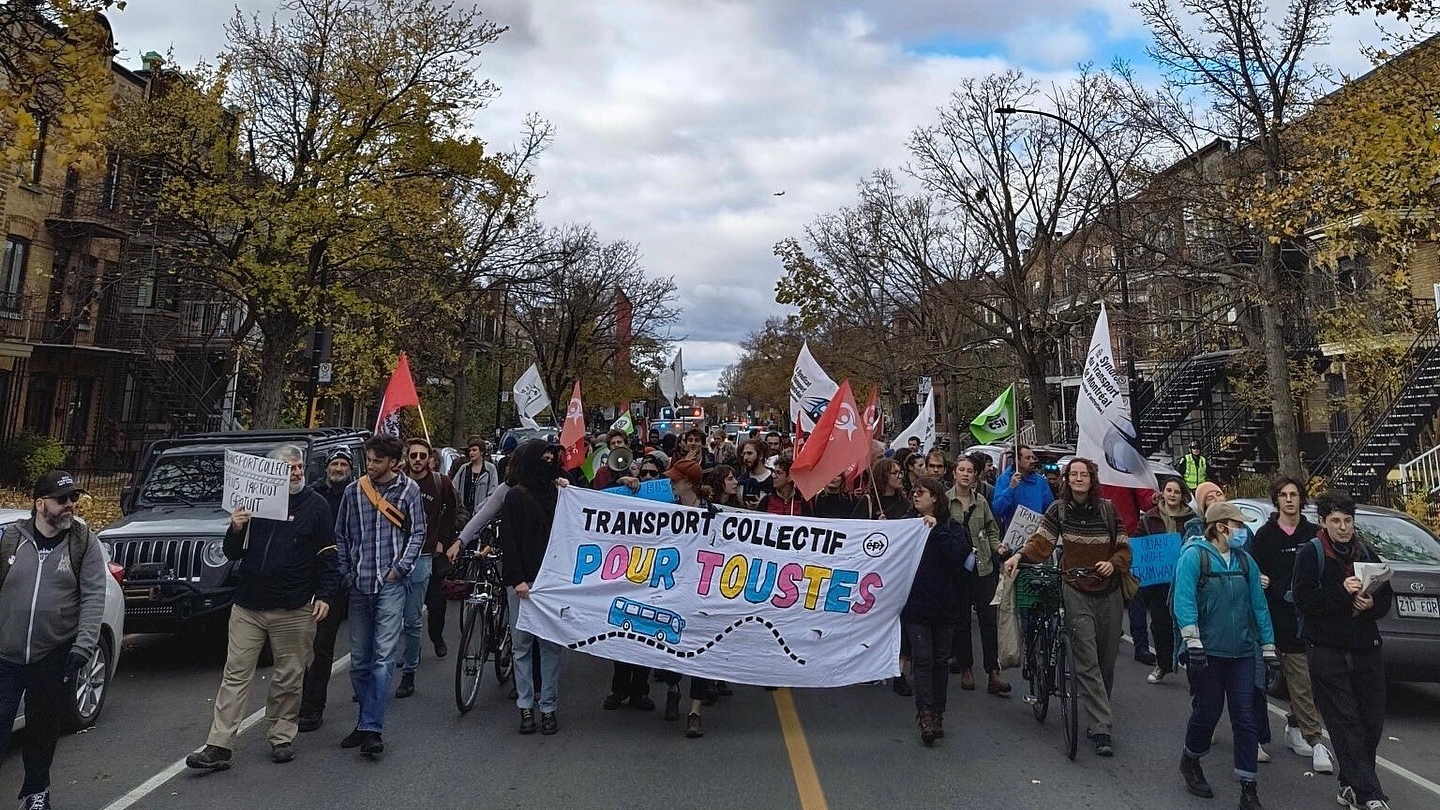
Transit-based solutions are particularly great local climate solutions to rally behind. Climate Justice Montreal’s Beyond Fares campaign bridges the climate crisis to daily lives of Montrealers. The campaign explains that not only do our carbon emissions decrease with greater use of public transportation (by reducing overall car use), but so do the social inequities associated with barriers to using public transportation around the city like income, ability, and neighbourhood service. It links together our social and environmental health to a well-supported public transportation, tying our fates together. While there’s perhaps no magic bullet to get us out of our socio-ecological crisis, public transportation is a good place to start.
This campaign lowers the friction that families often face when trying to get more involved in political advocacy [...] they can support a fare-free for youth public transportation campaign with the promise of a multiple factor return in the form of saved money, saved childcare time, a better climate, and a more equitable community.
Fare-free for youth goes beyond this by further humanizing transit as a climate solution. This sub-campaign focuses on the youth demographic, arguing for free transportation for children under the age of 18. Currently, transit is free for children under 11 (if accompanied by a paying adult) and for adults over 65. The precedent has been set to expand free transportation to all children, including the parallel arguments made to implement the over 65 age category–namely the way free transportation increases people’s affordability and independence. Studies across the country of fare-free transportation initiatives show that youths benefit significantly from accessing free public transportation, noting specifically the ways in which it unlocks a sense of independence and reduces financial burdens on themselves and/or their families. With greater access to public transportation, resources and opportunities across the city are unlocked. Money is no longer a barrier to meeting up with friends, going to school or after-school activities, volunteering, accessing health and wellness resources, getting to a part-time job–the list goes on! Investment into youth public transportation programming supports youths’ development and safeguards their future.

Appealing to families’ health, wellbeing, and affordability draws in new familial audiences that have traditionally been under-mobilized in the climate movement. This campaign lowers the friction that families often face when trying to get more involved in political advocacy. It offers efficiency for families: they can support a fare-free for youth public transportation campaign with the promise of a multiple factor return in the form of saved money, saved childcare time, a better climate, and a more equitable community.
The truth about impactful climate justice solutions is that they are often mundane [...] However, a successful campaign like that of Climate Justice Montreal can spin the mundanity of everyday into the site of activation and inspiration.
About 1 in 6 Montrealers are under 18, which represents a large proportion of the population whose lives would be changed should they be able to increase their public transportation access. Additionally, of those ~17% of youth who would benefit from this policy, they will grow up to expect a culture of accessing public transportation for free. This will create a generation of young adults who demand further discounts as they age (affordability and clean air are things young adults would probably prefer not to lose simply due to being older!). The campaign then becomes embedded within the expectations of young adults who will continue to advocate for greater fare access to the system.
The truth about impactful climate justice solutions is that they are often mundane. Public transportation, while sometimes attention-grabbing with a new bus or train, is ultimately just a mobility tool to help people get around a city. However, a successful campaign like that of Climate Justice Montreal can spin the mundanity of everyday into the site of activation and inspiration. The Beyond Fares and Fare-Free for Youth campaigns engage new audiences across quotidian struggles of mobility around the city, mobilizing neighbours together to rally for affordable, equitable, and green change.
