


In Quebec, this technocratic ordering was both spatial and cultural. Urban planning in the mid-twentieth century became one avenue through which the province sought to inscribe a distinctly Québécois identity within the broader geography of the nation. Putting Quebec on the map, both literally and symbolically, materialized the contradictions of liberation and control in the city’s built form. The Quiet Revolution is often remembered as a landmark moment through which the province embraced secularism, autonomy, and modernization. Yet its quietness was never silence. Orchestrated by the prophecy of progress, the city hummed with the sound of its own remaking. New structures rose as old ones crumbled, and its reforms reverberated spatially, reshaping Montreal to echo the whispered refrain of “maîtres chez nous.”
Reclaiming the Narratives of Chinatown
by Elizabeth Dresdner
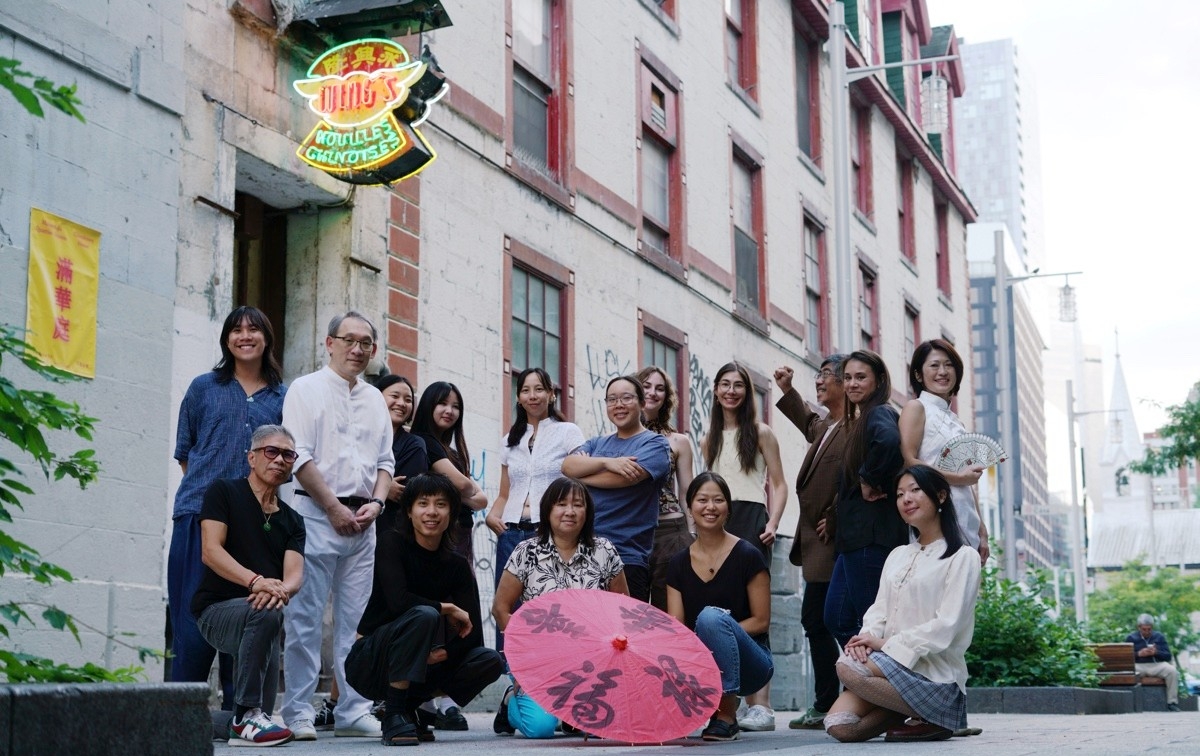 Photo credit: Andrew The-Anh Luk
This piece was selected as part of SHIFT's special edition issue Shaping Our City (November 2025), which invited pieces from our community related to what it means to design a more equitable city.
A city is never static: it is nebulous, constantly being imagined, planned, and shaped by those who inhabit it. From the tip of the Mount Royal cross to the sediment at the bottom of the Lachine Canal, Tiohtià:ke, which we have come to know as Montreal, tells a story of ongoing negotiation over how — and for whom — the city should be designed. For every state-led renewal or market-driven redevelopment undertaken, there is an answering movement from those displaced by it. The city’s form reflects an ongoing tension between imposed visions and lived realities, producing layered and recurring cycles of displacement.
“[We must] recognize space as always under construction. Precisely because space on this reading is a product of relations-between, relations which are necessarily embedded material practices which have to be carried out, it is always in the process of being made. It is never finished; never closed. Perhaps we could imagine space as a simultaneity of stories-so-far.” (Massey, 2005, p.9)
If we see the city as a continuous process of negotiation, then its transformations — and resistances — can be understood as overlapping narratives continually rewritten through lived practice. Its tangible manifestations, such as infrastructure and public spaces, materialize within these entangled relations. Urban transformation in Montreal has always unfolded unevenly across racial, class, and geographic lines. However, it is precisely in this unevenness that solidarities emerge; not solely as acts of survival, but as methods of (re)claiming neighbourhood change.
The Quiet Ordering of Montreal
In Canada, spatial injustice and displacement tell a long and continuous story, concretized into the nation’s foundation as a colonial project. Standing on unceded Kanien’kehá:ka territory, the scaffolding of extraction, displacement, and erasure continues to prop up what we know as Montreal today. From the imposition of cadastral grids and land concessions under French and British regimes to the twentieth-century projects that promised renewal, the making of Montreal relied on the rational ordering of space. Constructing the city from a bird’s-eye view necessitated rendering the city legible, reducing social realities into codified forms, often at the expense of local complexities and epistemologies. Urban planning became an instrument of the state’s technology of legibility, converting landscapes into maps, people into datasets, and livelihoods into economic functions.
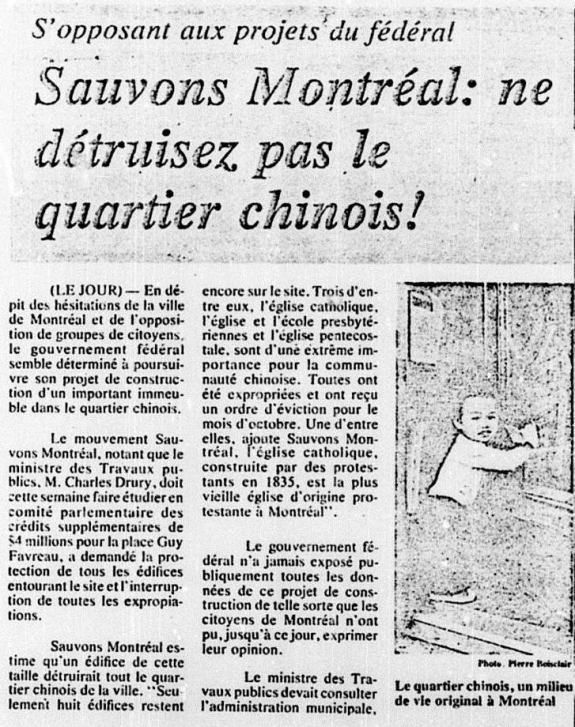 Article covering the opposition of the construction of the Guy-Favreau Complex from Le Jour, 1976.
Source: City of Montreal Archives
Article covering the opposition of the construction of the Guy-Favreau Complex from Le Jour, 1976.
Source: City of Montreal Archives
From the expropriations of Little Burgundy to Chinatown’s western blocks, modernization and nationalism danced in harmony in Montreal’s mid-century planning spectacle. Expressways, megaprojects, and renewal schemes were instrumental in this performance, in which the choreography of progress relied on the dislocation of those relegated backstage.
Community action has always been intertwined with Montreal’s development, as the erosion of neighbourhood ties has continually been challenged by those most affected.
Although Montreal is not unique in this regard, as these forces operate at a global scale, their repercussions manifest daily in localized contexts. Our systems of management and governance remain tethered to models that fragment our cities, driving affordability crises and eroding heritage. The logics of progress, economic growth, and modernity that inform urban policy and planning toward the façade of a “world-class city” result in an asymmetrical distribution of benefits, predictably to the detriment of communities habitually maintained in states of precarity.
Montreal is a city that has repeatedly redefined the boundaries of solidarity and the practices that underpin it. From the colonization and dispossession of Indigenous peoples to centuries of religious, linguistic, and nationalist contestation — to the political transformations of the Quiet Revolution — each period has represented enduring struggles over rights, identity, and self-determination. These processes are not incidental: they are central to how (re)development unfolds as an ongoing negotiation of belonging.
Chinatown as a Microcosm
Community action has always been intertwined with Montreal’s development, as the erosion of neighbourhood ties has continually been challenged by those most affected. Montreal’s Chinatown is a microcosm of these urban contradictions—a neighbourhood chronicled by intertwined forces of exclusion, displacement, and resilience. Emerging in the 19th century amid racial discrimination and exclusionary policies, Chinatown formed through self-constructed networks of mutual support and survival. Early Chinese residents—factored out of mainstream employment and services—transformed marginal spaces into sites of belonging. These fabrics were sustained through both tangible and intangible heritage, both anchored by association buildings, religious institutions, and rowhouse residences, and lived through the generations that have inhabited them. Together, they laid the foundation for a neighbourhood rooted in self-determination, where the bonds of mutual aid continue to hold the community together today.
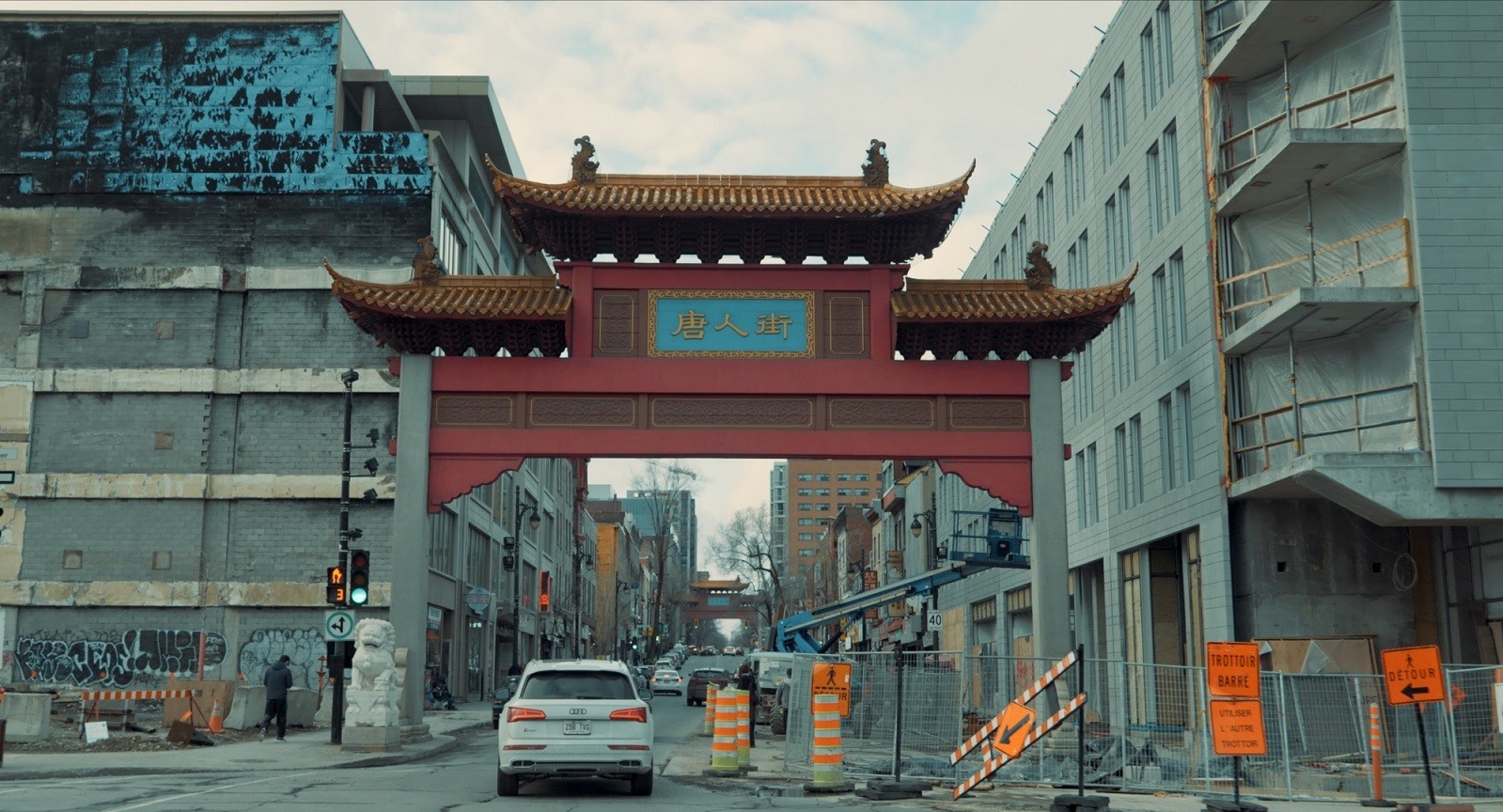 Photo from Big Fight in Little Chinatown (2022) directed by Karen Cho
Over the decades, Chinatown has endured repeated incursions: expropriations that resulted in the loss of two-thirds of the built fabric, or more recent pressures of speculative redevelopment. Thus, the tension between exclusion and persistence is inscribed directly in the neighbourhood’s form, as new-build condominiums tower over century-old association buildings, empty storefronts remain vacant while tourists pass by, and projects like Place des Montréalaises are erected to “provide a gateway to Vieux-Montréal from downtown” without acknowledging the neighbourhood they border. These overlapping conditions are not contradictions but continuities of Chinatown enduring as an “in-between” urban space, where lived histories persist despite systemic pressures to sanitize, modernize, or, more recently, touristify.
Each swell of disruption has tested the neighbourhood’s capacity to adapt while also revealing its strength. Its survival speaks to a deeper resilience rooted in collective stewardship, one that continues to contest the city’s choreography of erasure. Chinatown functions as both a microcosm of other marginalized neighbourhoods and a macrocosm of Montreal’s urban condition: where the city’s wider tensions are magnified.
Chinatown: A Model and a Mode
Nevertheless, the vernacular of resilience, strength, and displacement that so often characterizes neighbourhoods like Chinatown offers little in the way of intervening in these cycles of displacement. Resilience alone cannot replace justice. To endure without confronting the structures that produce harm risks naturalizing precarity as a condition of urbanity. Reactive urbanism is not revolutionary urbanism — it absorbs impact but leaves the structure hollow. True intervention begins when the ground itself shifts, when communities are not simply resilient within change, but become the authors of their own.
Narrative transforms urbanism from a technocratic process into a democratic one, acknowledging that planning is not only about what is built, but about what is lived.
In Chinatown, this shift has already taken foot. Community action has evolved from a posture of reactive resilience to proactive strategy. Through policy advocacy, downzoning, partnerships with research institutions, and participatory planning, Chinatown’s actors are no longer responding to displacement but reshaping the frameworks of planning itself.*
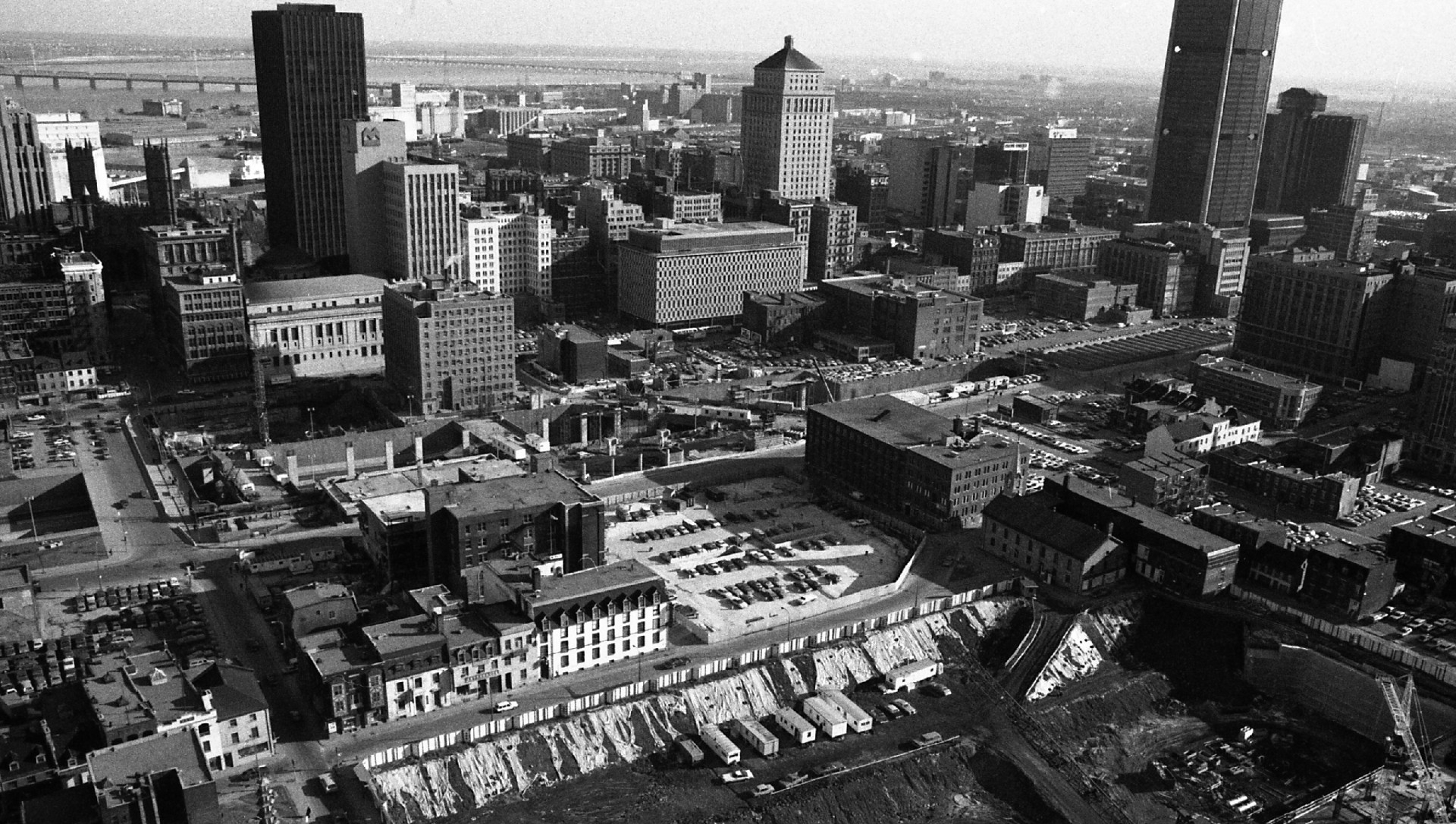 Aerial view of the Guy-Favreau Complex construction site. 1981.
Photo by Philippe Dumais. City of Montreal Archives. VM94-B259-025.
Aerial view of the Guy-Favreau Complex construction site. 1981.
Photo by Philippe Dumais. City of Montreal Archives. VM94-B259-025.
The strategies taking root in Chinatown crystallize alongside movements across Montreal — from Parc-Extension to Milton-Parc — where residents have disrupted the rhythm of speculation by constructing collective frameworks of ownership and care.* These initiatives are not merely protective but generative: they reclaim neighbourhood change through community ownership as a strategy and a social relation. In this convergence of struggles and stories, Chinatown resonates beyond its marked borders. It becomes a way of thinking and participating in the urban: a reminder that models are never static, and that modes of being, once shared, can remake the city itself.
To resist domination is not only to oppose power, but to transform it — turning resistance into creation and imagining futures in which communities define the terms of their own endurance.
Narrative as Planning
Urban planning has long claimed authorship over the city through maps, plans, and priorities. Yet the multiplicity of the city is known only through those who inhabit it. Their stories do not sit beside planning: they constitute it, mediating between perception and possibility. In Chinatown, stories themselves have become a form of planning. The tangible and the intangible heritage are inseparable: architecture and memory, structure and sentiment, are related in the ways that makes these spaces matter. Heritage, too, is an ongoing process—never static or sealed in time. Chinatown is alive—lived and living—and those who reside, work, and gather within it actively shape its continuity. These narrative practices resist abstraction, keeping lived experience at the center of urban transformation. Narrative transforms urbanism from a technocratic process into a democratic one, acknowledging that planning is not only about what is built, but about what is lived.
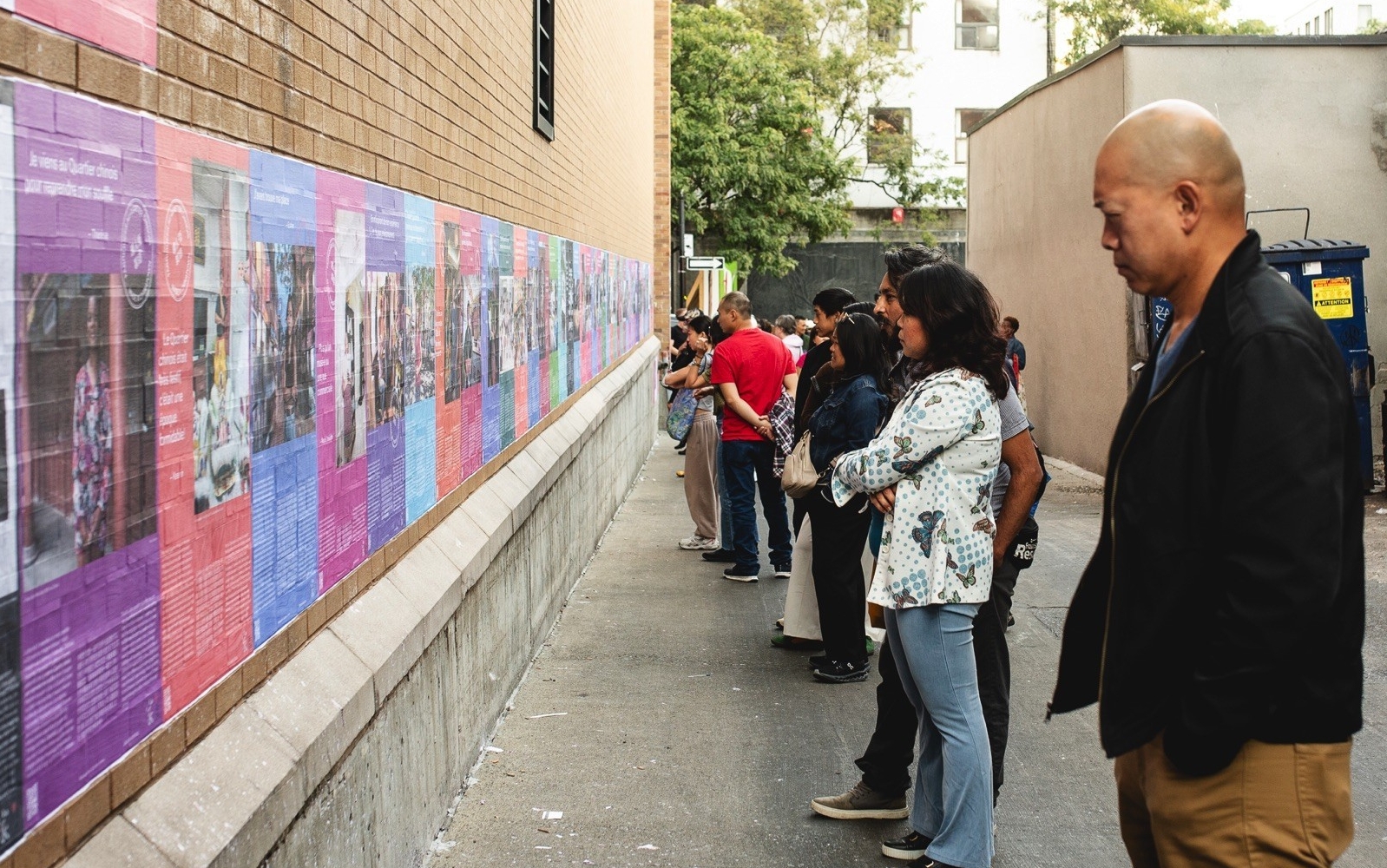 Public storytelling exhibition Made in Chinatown, led by JIA and Chris Lau, highlighting everyday stories, memories, and hopes of community members on Clark Street.
Source: Rachel Cheng
Public storytelling exhibition Made in Chinatown, led by JIA and Chris Lau, highlighting everyday stories, memories, and hopes of community members on Clark Street.
Source: Rachel Cheng
Memory operates as a form of political and spatial design: through oral histories and community archives, placing community voice into first person and present tense emerges as an emancipatory act. These histories are not merely cultural artifacts. They are spatial interventions contesting erasure and proposing alternative geographies of belonging.
Imagining Otherwise
If space represents a “simultaneity of stories-so-far,” then the city is an unfinished text, one that is continually being rewritten. In order to plan otherwise, we must first imagine otherwise. The right to the city is not only a right to occupy space but a right to co-author its ongoing story, to intervene in how urban narrative is written and by whom. Chinatown’s story offers a vocabulary for such reimagining. It reminds us that resistance is not only oppositional but creative: it builds new forms of solidarity, knowledge, and governance. To resist domination is not only to oppose power, but to transform it — turning resistance into creation and imagining futures in which communities define the terms of their own endurance. These acts bend the horizon towards a different urban landscape: one rising in collective authorship and sustained continuity.
To learn more about what community action looks like in Chinatown, read our other piece showcasing the JIA Foundation, or head to their website to read their research on Collective Real Estate Tools in Parc-Extension and Milton-Parc.
Bibliography
Cha, J. (2004). La représentation symbolique dans le contexte de Ia mondialisation: L’exemple de la construction identitaire du quartier chinois de Montréal. Journal de La Société Pour l’étude de l’architecture Au Canada, 29(4), 3–18.
Ellis-Young, M. (2025). Urban transformation and Indigenous-settler reconciliation: Discursive (dis)connections between municipal reconciliation strategies and area redevelopment plans in five Canadian cities. Cities, 167, 106350. https://doi.org/10.1016/j.cities.2025.106350
Ferro, L., György, E., Oláh, G., Teixeira Lopes, J., Sonkoly, G., Apolinário, S., Azevedo, N., & Ricardo, J. (2024). Gentrification and touristification in urban heritage preservation: Threats and opportunities. Cultural Trends, 1–16. https://doi.org/10.1080/09548963.2024.2352407
Kelly, B. M. (2010). The Transformation of Landscapes in Southwest Montreal and Identity Formation During the Quiet Revolution [Dissertation, University of Toronto]. https://utoronto.scholaris.ca/server/api/core/bitstreams/952f09dc-b0b0-41af-a957-c97bb9d2dda9/content
Luce LaFontaine Architectes. (2021). Étude de l’évolution historique et caractérisation du Quartier chinois.
Massey, D. (2005). For Space. SAGE Publications. https://books.google.ca/books?id=RCIRAQAAMAAJ
Roy, A. (2005). Urban Informality: Toward an Epistemology of Planning. Journal of the American Planning Association, 71(2), 147–158. https://doi.org/10.1080/01944360508976689
Scott, J. C. (1998). Seeing Like a State. Yale University Press; JSTOR. http://www.jstor.org/stable/j.ctt1nq3vk
Ville de Montréal. (n.d.). Place des Montréalaises: A square designed to celebrate the role of women. Retrieved October 27, 2025, from https://montreal.ca/en/articles/place-des-montrealaises-square-designed-to-celebrate-role-women-19217