

Critical Mass Montreal: Riding Together for a More Cyclable City

by Olive Zeynep Kartal

Photograph of a number of cyclists on a Montreal street. One of the bikes is pulling a car with seating, on which is a man playing an electric guitar. From a Critical Mass ride. Photo credit: Zvi Leve
You might have already seen us. Perhaps you rode with us on a Friday afternoon and felt the freedom and sense of community of cyclists taking over the streets. Perhaps you were walking and saw a group of cyclists pass, waving and ringing their bells, and wondered what was going on. Perhaps you were in a car, stuck behind a wall of cyclists; perhaps you honked for us, or at us. 

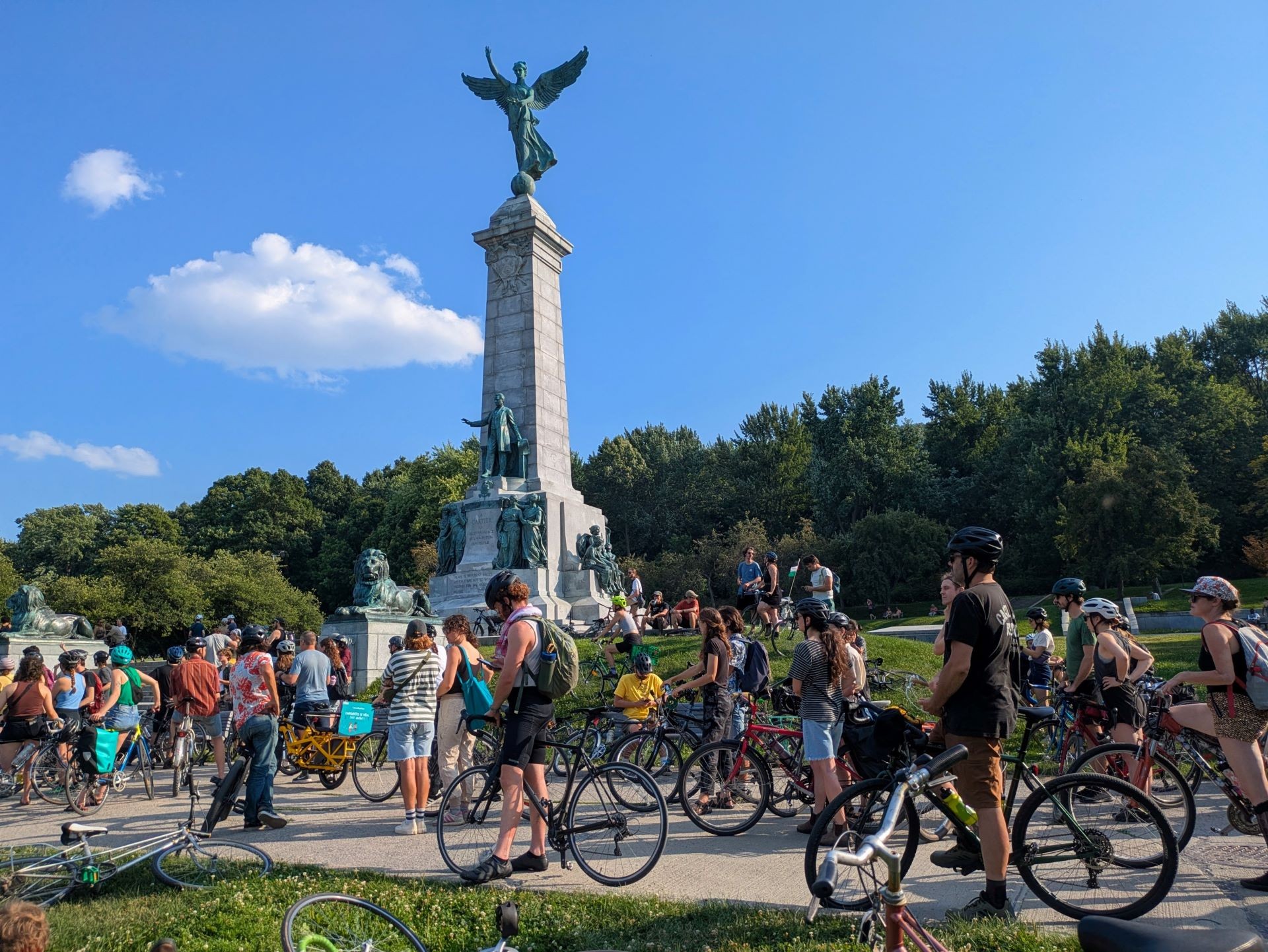
Critical Mass is a “manifestive” bike ride that happens every last Friday of the month (Instagram @masse_critique_montreal). Cyclists meet at the Statue of Mont-Royal and ride together in a group ranging from 50 to 500 participants. They take over the streets, riding to draw attention to accessibility and mobility issues affecting cyclists, among other causes.  

People ride for cycling visibility, accessibility, mobility, to be part of and create a community, to enact change, and to move freely through streets that should belong to all of us.

The reasons for Critical Mass’ activism are as diverse as the riders themselves. At any given ride, you will see anyone from students, activists, families, parents, kids, bike messengers, athletes, artists, racers; people on bikes, Bixis, e-bikes, cargo bikes, fixies, monocycles, or even rollerblades; people who bike for fun, pleasure, transport, activism, work... All these people from diverse backgrounds become united around one common cause and its means: the bike. People ride for cycling visibility, accessibility, mobility, to be part of and create a community, to enact change, and to move freely through streets that should belong to all of us. Cyclists can be heard chanting our slogan: À qui la rue? À nous la rue! Whose streets are these? Ours! 

The roots of Critical Mass

The decentralized structure of Critical Mass allows for flexibility and openness. There is no leader; the ride can be organized by anyone, and you might even find yourself at the front. There is no set route, and the group decides where to go together. Some points of interest may be decided beforehand at a meeting open to everyone. For example, the October 31 ride, which took place right before the municipal elections, passed through Avenue Querbes, a bike lane that was in danger. Since there is no set route, the ride can bypass permissions and police presence. In fact, Critical Mass discourages police presence–cyclists are more than able to secure the streets and navigate the circulation on their own. 

Montreal’s Critical Mass draws its history from the Critical Mass movement that started in San Francisco and quickly spread around the world–a local ride, but internationally. The first Critical Mass took place on September 25, 1992 in San Francisco where cycling conditions were downright dangerous. One early slogan was: “We’re not blocking traffic, we are traffic”. The idea spread globally, inspiring local adaptations everywhere. Nowadays, several cities hold Critical Mass rides every last Friday of the month.  

Montreal’s cycling activism roots can also be traced back to Robert “Bicycle Bob” Silverman and Claire Morissette and the association they founded, Le Monde à bicyclette. The protests and activism of Le Monde à Bicyclette helped secure the infrastructure and the rights we benefit from today, such as the north–south cycling corridor and the right to bring bikes on the metro. On June 4, 1977, the association organized International Bicycle Day which drew 5,000 cyclists into the streets. Critical Mass sits within that lineage of grassroots activism for urban change. 

Photograph of cyclists for Critical Mass in Parc Mont-Royal From a Critical Mass ride. Photo credit: Zvi Leve
When I talked to Mathieu Murphy-Perron, a bike activist, content creator on cycling (@matness) and organizer with Vélorution, he reminded me how bike activism has recently brought direct change to the city. For example, he reminds me about the death of Mathilde Blais, a cyclist who was hit by a truck on Saint-Denis in April 2018.  A ghost bike was placed at the spot where she died: her death, and the resulting biking activism that came from it ultimately pushed the city to act and create REV Saint-Denis, a bike path that provides fast connections for cyclists. The inauguration of the bike path brought new life and vibrancy to the street. Today, Saint-Denis is a vibrant neighbourhood hub for cyclists, pedestrians, and businesses alike

A similar action took place in September 2025 as a die-in on Park Avenue after a cyclist died after being hit by a truck. Cyclists laid on the street, blocking circulation, demanding for cycling infrastructure and lower speed limit on Park Avenue. 

Navigating "bikelash" in Montreal

There are holes in the cycling network, both literally and metaphorically. Take for example another recent incident: a cyclist who fell into an uncovered hole covered by rain in the Saint-Laurent borough. On November 7, 2025, at 8 a.m., Darlene Demchuk was riding her bike to work along a shared lane on Thimens Boulevard in the Saint-Laurent borough. She fell into a literal uncovered hole and required immediate facial reconstruction surgery. The cyclist had just experienced a terrifying incident, however, comments on a video on social media engaged in bikelash: “Why did she ride there when there were cones?” Demchuk had to explain that if she hadn’t gone through the cones, she would have been on the street, which could have been equally dangerous. Either way, she shouldn’t have had to fall down a hole–it shouldn’t have been left open. Such decisions, and the lack of infrastructure, leave cyclists exposed not only to danger but also to bikelash from the wider community. 

Bikelash has been described  as “the public’s irrational opposition to even modest bike lane improvement proposals”. During the last elections, bikelash became key political leverage. Most notably, Soraya Martinez-Ferrada of Ensemble Montreal, Luc Rabouin of Projet Montreal, and Gilbert Thibodeau of Action Montreal took up bike lanes as a politicized issue. Martinez-Ferrada said they would audit bike lanes, and Rabouin’s team put up signs along REV Saint-Denis and elsewhere, declaring “this path is in danger.” Bike lanes and cycling became a major issue, and our paths and accessibility routes were politicized. Cyclists quickly mobilized in response. 

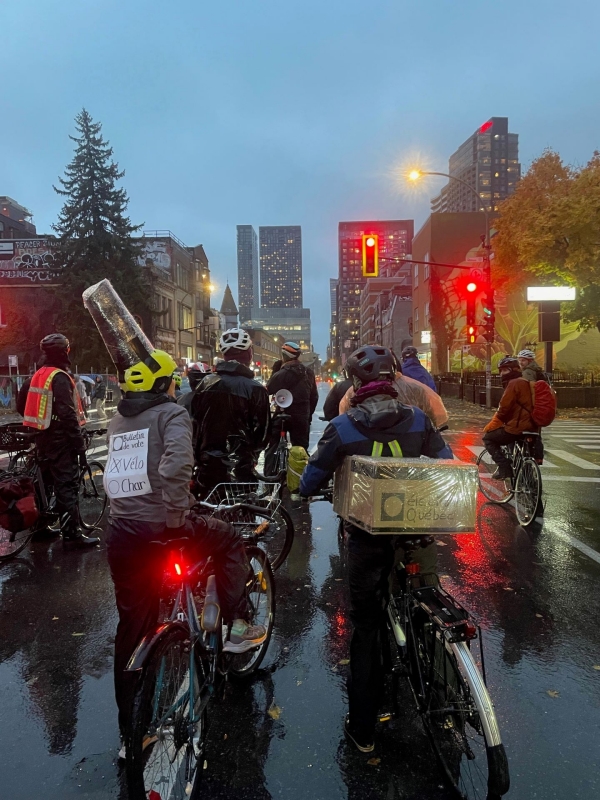
Photograph of cyclists for Critical Mass around the municipal election Photograph of cyclists for Critical Mass around the municipal election. Photo credit: Olive Zeynep Kartal

Critical Mass organized a special edition ride on October 31, right before the elections. Signs reading “Votez Vélo / Vote for Bikes” were hung by community members. Despite rainy and wet weather, around 200 participants joined the ride. People even came in costume–most notably as a voting ballot voting “for bikes”. 

Shortly after the elections, tensions remain high. The cycling community is holding its breath, waiting to see how Ensemble Montreal will address biking. In Outremont, the bike path on Lajoie may soon undergo transformation with its removal during winter. The removal of the 200-meter bike path during winter seems symbolic: cyclists wonder, once paths start being removed, how far will it go? The bike community is already mobilizing to organize a ride on December 2 to protect Lajoie. Similarly, a ride recently took place on REV Henri-Bourassa for its inauguration as it is also a path that is being put into question by some. Such cycling mobilisation is more important than ever when faced with an administration that puts the ongoing cyclability of the city in question. 
What do drivers really think of cyclists? People tell me the distinction is not so clear-cut in real life as it might seem online. Some drivers are also cyclists, and vice versa. Most interactions are reported to be more pacifist, although dangerous interactions and tension do occur. Mathieu tells me that even though 99% of cohabitation can go well, if 1–2 drivers react negatively, it can really ruin someone’s day. In my opinion, that’s comparable to what happens online–a small minority is very loud and very present. 

For women, children, and families, the accessibility issues are twofold. When infrastructure is unsafe, it is often the most vulnerable who are affected. Women are often responsible for most familial transport. Critical Mass participants mention that they ride for the mom, the dad, the parents bringing children to school, doing groceries, for the kids, for the women, for immigrants. Zyanya Pompa-Morales, a bike mechanic and World Bicycle Forum organizer, tells me that as a woman and immigrant, she finds herself being a target of drivers’ anger–so much so that she had to find ways to protect herself. 

One response to navigating bikelash is the creation of content and the dissemination of the message on social and traditional media. Mathieu is one person creating content around cycling. Raúl Garate also makes and shares videos. Zvi Leve tells me he takes photos to spread the message; his photos are available on Flickr. Matías Vazquez-Levi helped Critical Mass create Petition Maps, a site where people can mark problematic cycling areas in the city and leave comments. The resulting maps were sent to candidates before the election, and he hopes the maps can bring change. 

A Community of Cyclists and Beyond 

Biking is a liberatory and egalitarian form of transport. As Raúl Garate, an activist and content creator, tells me, during a time when public transit has become more expensive, cycling presents itself as an accessible and egalitarian option. And a legitimate form of transport, it is. Many of the people I spoke with for this interview describe the bike as life-changing–a tool of freedom, liberation, agency, and change. 

Critical Mass doesn’t just create a community for cyclists. Cyclists and pedestrians are natural allies (even though they might sometimes be pitted against each other). For Mathieu, the connections created with the witnesses of Critical Mass are as important. He can often be seen riding during Critical Mass, saluting pedestrians and inviting people to join us–offering an opening. When asked about his favourite moments during Critical Mass rides, he tells me that during one ride, someone yelled from their balcony, “Pourquoi vous faites ça? Why are you doing this?” His response, demonstrating the heart of the ride, was simply, “Parce que je vous aime. Because I love you all.” 

Biking allows a different perspective on the city. One’s ideas can change once seated on a bike, riding through the streets, interacting with its pedestrians, drivers, infrastructure, and everything in between. There is a sense of freedom that comes from biking, and a revolutionary potential that is there for all to explore.

Biking allows a different perspective on the city. One’s ideas can change once seated on a bike, riding through the streets, interacting with its pedestrians, drivers, infrastructure, and everything in between. There is a sense of freedom that comes from biking, and a revolutionary potential that is there for all to explore. Once one starts riding, an inner political transformation might take place. One might take on the identity of a cyclist as a political position. Cycling might transform one’s perspective of the city and its structures–transforming the city itself in turn. 

Critical Mass happens every last Friday of the month, navigating bikelash, demanding cyclability, and creating community. You might be one cyclist riding alone, but together we can make a change. Together, we are a community. So come ride with us.

The next Critical Mass rides are November 28, and December 26. See you there!

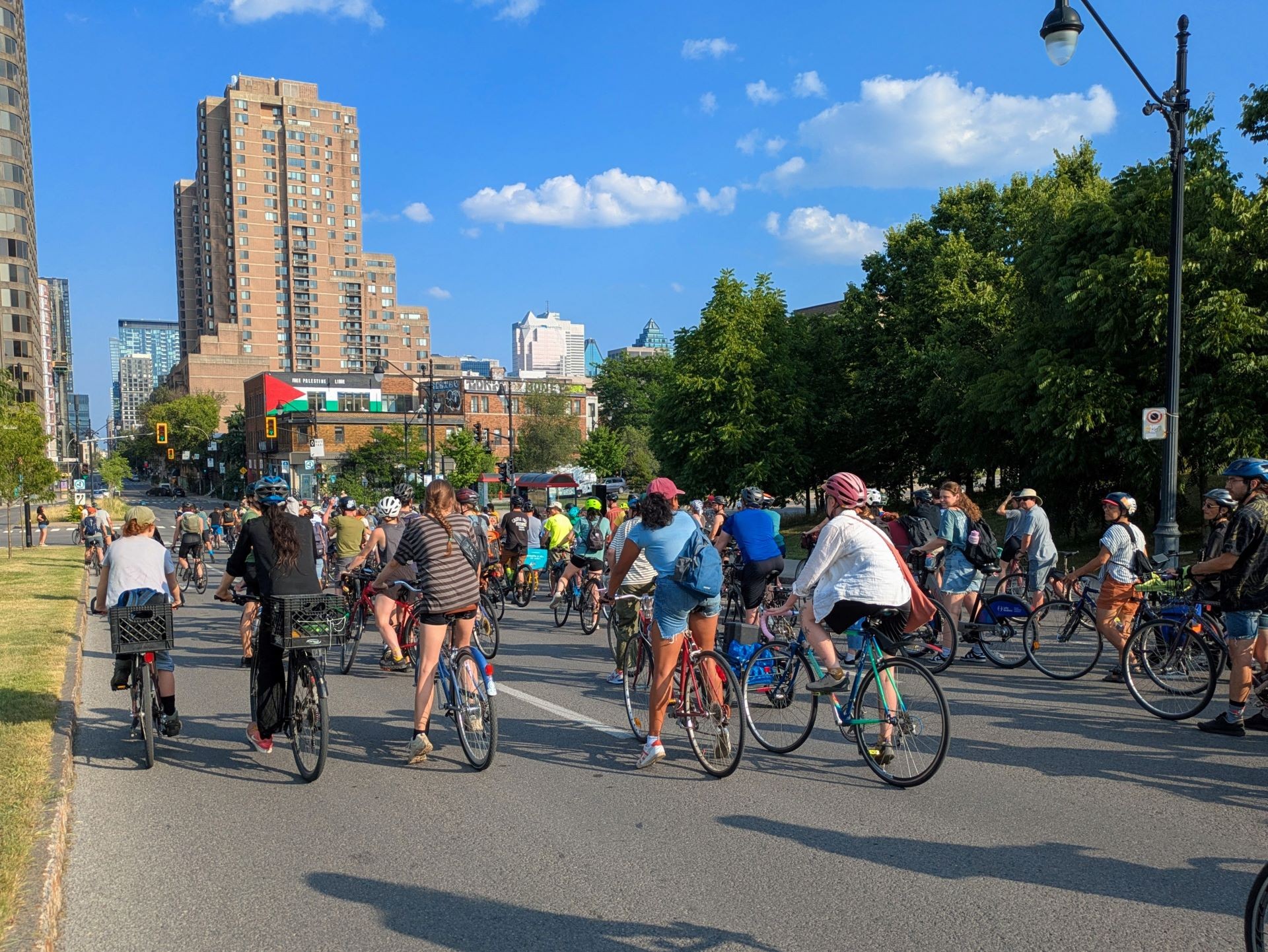
Photograph of a number of Critical Mass cyclists on avenue du Parc From a Critical Mass ride. Photo credit: Zvi Leve

Headshot of article writer Autumn Godwin

Olive Zeynep Kartal is a writer, editor, cook, and community organizer. She holds a BA in English and Cultural Studies from McGill University and an MA in Film and Moving Image Studies from Concordia University. She is the founder of The Margin Club, an initiative for the city’s writers and artists. She is a passionate cyclist and a regular Critical Mass participant. 

Bibliography

Boisclair, Valérie. “Le vélo fantôme de Mathilde Blais a été retiré et confié au Musée de la civilisation.” ICI Radio-Canada, May 2, 2021, https://ici.radio-canada.ca/nouvelle/1789715/velo-fantome-mathilde-blais-ceremonie-musee-civilisation-viaduc.

Carlsson, Chris, ed. Critical Mass: Bicycling’s Defiant Celebration. Edinburgh / Oakland: AK Press, 2002.

CBC News. “Cyclist Death in Montreal Demonstration.” CBC, September 2, 2025, https://www.cbc.ca/news/canada/montreal/cyclist-death-in-montreal-demonstration-1.7628542.

CTV News. “Montreal Cyclist Swallowed by Construction Pit, Needs Facial Reconstruction.” CTV News, November 13, 2025, https://www.ctvnews.ca/montreal/article/montreal-cyclist-needs-facial-reconstruction-after-mistaking-puddle-for-construction-pit/.

Dahlstrom-Eckman, Azul.“The Night That Changed San Francisco Cycling Forever,” KQED, February 23, 2023 (updated November 20, 2023), https://www.kqed.org/news/11941576/the-night-that-changed-san-francisco-cycling-forever.

J-Beaudoin, David and Jeremy Cox, “Bikelash: Contested Bike Lanes in Montreal.” The City (CJ Concordia), April 4, 2025, https://thecity.cjconcordia.net/bikelash-contested-bike-lanes-montreal/.

La Presse. “Quatre Ans Plus Tard, Qu’en Disent les Commerçants.” La Presse, December 1, 2024, https://www.lapresse.ca/actualites/grand-montreal/quatre-ans-plus-tard-qu-en-disent-les-commercants/2024-12-01/rev-rue-saint-denis/des-commercants-critiques-ont-change-leur-fusil-d-epaule.php.

Le Devoir. “Piste cyclable éliminée pour tout l’hiver à Outremont.” Le Devoir, November 20, 2025, https://www.ledevoir.com/actualites/transports-urbanisme/935544/piste-cyclable-eliminee-tout-hiver-outremont.

Laforge, Monique, “Le Monde à Bicyclette : vive la vélorution!” in Mémoires des Montréalais, Ville de Montréal, December 12, 2016, https://ville.montreal.qc.ca/memoiresdesmontrealais/le-monde-bicyclette-vive-la-velorution.

Noakes, Taylor C. “Latest Bit of Montreal ‘Bikelash’ Sidesteps the Facts to Please Bike‑Lane Haters.” Cult MTL, September 18, 2025, https://cultmtl.com/2025/09/latest-bit-of-montreal-bikelash-sidesteps-the-facts-to-please-bike-lane-haters/.


Back to top

© Concordia University