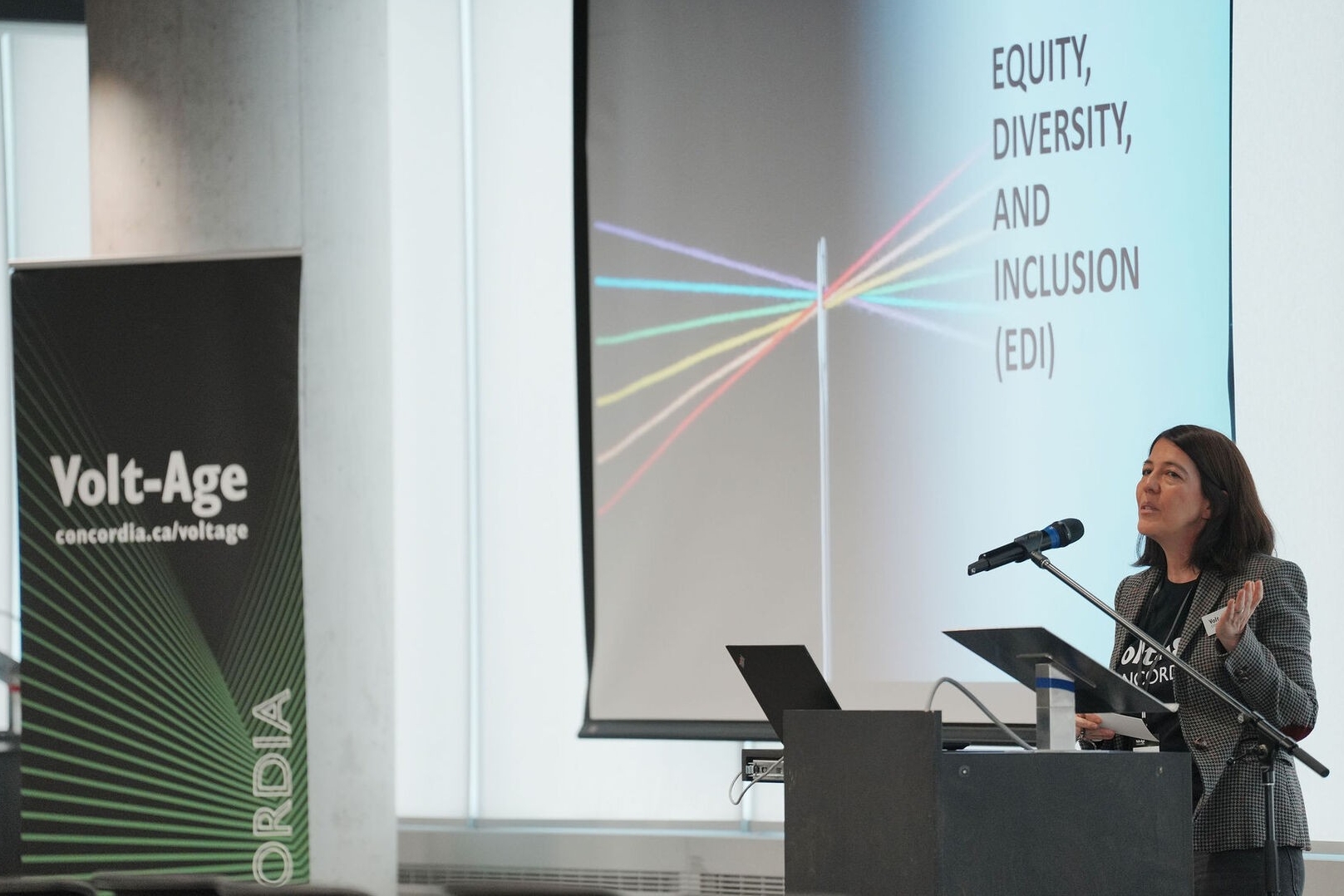
EDI at Volt-Age
Volt-Age is committed to advancing innovative and inclusive research by embedding Equity, Diversity and Inclusion (EDI) principles into all aspects of academic research.
By placing EDI at the heart of our mission to support impactful research on electrification, we aim to help ensure that societal changes underway, including the transition to clean energy, benefit all communities, particularly those from equity-seeking groups.
Systemic barriers
Policies, practices and cultural norms, deeply embedded within institutions and research systems that unintentionally disadvantage or exclude individuals and groups based on gender, Indigenous identity, race, disability or other intersecting identities.
There are several systemic barriers that make it difficult for underrepresented groups to participate in, or access the benefits of electrification. Volt-Age's EDI Action Plan prioritizes addressing these barriers. The examples below represent only a selection of the systemic barriers that exist within the electrification landscape. This is not an exhaustive list, but an illustration of the complex and interconnected challenges that must be addressed to ensure an equitable energy transition.
- Gender biases in science, technology, engineering and mathematics (STEM) and innovation:
Lack of structural support for women in STEM and innovation fields leads to lower numbers of women with patents and lower rates of publication for women in engineering fields. - Narrow framing of research outputs:
Lack of inclusivity in formulating and communicating research outputs can perpetuate biases, limit benefits for marginalized groups and create persistent negative impacts. - Cisgender and heteronormative values in STEM:
Issues of queer belonging and a lack of role models can create feelings of isolation for 2SLGBTQIA+ individuals. - Resilience as a primary objective:
Overemphasis on resilience as the main goal of energy projects tends to obscure systemic barriers that force marginalized communities to build resilience in the first place. - Access to STEM for disabled individuals:
Attitudinal barriers, challenges in accessing accommodations and exclusive environments create obstacles for disabled individuals in academic and professional settings. - Overlooked impacts on Indigenous communities:
Energy projects have often violated treaties and disrupted traditional governance and livelihoods for Indigenous communities due to a lack of inclusion and disregard for Indigenous sovereignty. - Data and knowledge gaps:
A lack of disaggregated data on race, gender, disability, income and geography limits the ability to identify inequities and design targeted interventions in the electrification sector. - Affordability and access:
Many households and communities—particularly those with low incomes or in rural and remote areas—face financial and logistical barriers to adopting electric technologies or accessing clean energy programs. - Policy and regulatory gaps:
Existing policies and incentives often overlook equity considerations, favoring large-scale industrial or urban projects over community-led and inclusive solutions.
EDI resources
We have curated a list of resources from organizations like SSHRC, NSERC, and CIHR to provide guidance on integrating EDI principles into research design and practice.
EDI Action Plan
Volt-Age's EDI Action Plan is our roadmap for embedding Equity, Diversity and Inclusion across all aspects of our research, governance and partnerships. It is grounded in established best practices and is a living document that continue to evolve with input from collaborators and as new ideas and opportunities arise.
Volt-Age's EDI Action Plan is built on 4 pillars:
Ensure meaningful inclusion of diverse voices in Volt-Age decision-making and in the administration of the research program.
- EDI Committee
Form and convene an EDI Committee regularly (four times per year). - Climate survey
Conduct a climate survey every two years and self-identification surveys annually to support monitoring and reporting. - Funding assessment
Assess funding decisions using best practices and an analysis of the applicant pool. - Representation in governance
Ensure diverse representation across all governance bodies.
Promote research and innovation that are socially just and inclusive.
- Fund inclusive projects
Support the development of inclusive projects and assess their implementation using Gender-Based Analysis Plus (GBA+). - Research design
Embed EDI principles in project design. - Accessible lab space
Build and renovate spaces to be fully accessible to all participants. - Co-leadership with Indigenous partners
Facilitate the participation of Indigenous partners through strong, trusted relationships. - Inclusive publication and patenting
Guide and fund equitable, fair and diverse practices. - Intellectual Property (IP) and commercialization
Embed GBA+ and EDI principles in commercialization strategies and research-to-market pathways.
Increase EDI knowledge, capacity and leadership among researchers, research trainees, administration and highly qualified personnel (HQP).
- EDI workshops
Host workshops on topics such as anti-bias, hiring, inclusive leadership, GBA+, publishing and patenting and more. - Scholar-in-Residence
Open a Scholar-in-Residence program for atypical candidates whose research relates to EDI and the energy transition. - Indigenous Bridging Program
Build interest in engineering and science among Indigenous communities. About Concordia’s Indigenous Bridging Program. - Milli-Volt youth summer program
Provide equitable capacity building for the next generation of scientists. - EDI in electrification micro-program
Develop practical skills and knowledge among students through a bespoke interdisciplinary microprogram. - Just Transition certificate
Offer credentials in EDI and the energy transition, including practical tools and context.
Support cutting-edge research on the state of EDI in Volt-Age and in the broader domain of electrification.
- Impact assessment of trainings
Assess the successes and challenges experienced by participants in Volt-Age EDI trainings. - Community needs assessment
Assess and respond to the needs and priorities of Living Lab host communities. - EDI monitoring of publications and patents
Report on progress made. - EDI assessment
Analyze calls for proposals, applications and other metrics. - Co-create funding calls
Ensure calls respond to community needs. - Assessment of Indigenous participation
Assess the participation of Indigenous collaborators across events, research and governance. - EDI research call
Target funding call for research on EDI in electrification in Canada.
EDI support
Need EDI support for an existing Volt-Age project?
Reach out to the Volt-Age EDI team at volt-age.edi@concordia.ca.